Categories
Real Estate

Hanson Capital Weekly Newsletter #6– April 23–29: Market Moves & Investor Insights

Market Insight #1: Prologis Reports Increased Demand Amid Trade Uncertainty

Prologis, the world’s largest industrial real estate company, anticipates ongoing global trade tensions will drive increased demand for U.S. warehouse space. Companies are strategically stockpiling goods closer to consumers to mitigate tariff-related supply chain disruptions, leading to a surge in leasing activity.

Despite recent slowing of leasing activity and warehouse vacancy rates edging upward to 7% in Q1 2025, Prologis posted strong financial results, including a 9.2% revenue increase to $2.14 billion and net earnings of $592 million. The firm maintains its full-year earnings guidance, predicting further strength as limited warehouse construction constrains new supply and sustains rental rates.

Source:

Market Insight #2: Financial Markets Send Mixed Signals Amid Economic Uncertainty

April 2025 has brought unusual behavior in financial markets, as both stocks and bonds experienced simultaneous gains—a rare occurrence causing concern among analysts about potential synchronized declines ahead. Many attribute this anomaly to erratic U.S. policy shifts and lingering economic uncertainties.

A recent JPMorgan investor survey underscores this uncertainty: 93% expect the S&P 500 to remain at or below 6,000 over the next year, with nearly a third predicting a fall below 5,000. These forecasts represent a stark shift from earlier bullish sentiment, driven by fears of stagflation and unpredictable economic policies.

Sources:

Investor Concept of the Week: Capitalizing on Real Estate Resilience Amid Market Uncertainty

The current market presents contrasting signals: industrial real estate continues demonstrating resilience, driven by strategic shifts in global trade and supply chains, while financial markets grapple with volatility and economic uncertainty.

Key Insights:

  • Industrial Stability: Prologis’s recent performance highlights ongoing demand strength in strategically positioned warehouse spaces, indicating industrial real estate as a stable asset class amid market turbulence. 
  • Financial Market Volatility: Investors express caution due to rare simultaneous strength in stocks and bonds, signaling potential for market volatility and uncertainty ahead. 

Investor Move:
In volatile market conditions, investors should lean into assets like industrial real estate that show fundamental resilience and steady tenant demand. These uncertain times give us more conviction on why we like multi-tenant diversified cash flow in our investment targets today.  Prioritize strategically located, operationally strong industrial properties that can weather short-term economic fluctuations.

Final Thoughts

Despite heightened financial market uncertainties, industrial real estate remains a bright spot, supported by structural trends such as reshoring, e-commerce, and robust logistics demand. Hanson Capital continues to position our portfolio toward these resilient opportunities, aligning our strategies with evolving market conditions to protect and grow investor capital, although with the uncertainty, we’re shifting our risk reward profile towards acquisition over new development.
Categories
Real Estate

Hanson Capital Weekly Newsletter #5 – April 16–22: Market Moves & Investor Insights

Market Insight #1: Industrial Leasing Activity Rebounds in Q1 2025

The U.S. industrial real estate sector is showing signs of momentum. According to JLL, leasing activity reached 123.3 million square feet in Q1 2025—the strongest quarter since Q2 of last year. Leasing for spaces between 100,000 and 250,000 square feet made up over 27% of the total, indicating robust demand in the mid-bay segment although vacancy edged up to 7.3%, driven largely by deliveries of unleased new product. While that’s still healthy by historical standards, it signals that tenant selectivity is returning to the market

Source:

Market Insight #2: Tariff Uncertainty Impacts Construction Costs and Project Timelines

Recent tariff policies have introduced new challenges for industrial developers. According to a report by Business Insider, tariffs on imported steel and aluminum have led to significant cost increases for construction materials. For instance, a warehouse project in Newark experienced an 8–10% rise in steel costs, adding approximately $2 million to the budget These escalating costs are causing developers to reconsider project timelines and budgets, potentially leading to delays or cancellations of planned developments. The uncertainty surrounding future tariff implementations further complicates long-term planning in the industrial construction sector

Source:

Investor Concept of the Week: Navigating a Market with Rising Demand and Construction Headwinds

The industrial real estate landscape in Q1 2025 presents a complex picture: strong leasing activity indicates robust demand, particularly in the mid-bay segment, while rising construction costs and tariff-related uncertainties pose challenges for new developments

Key Takeaways:

  • Strong Demand: Leasing activity has rebounded, with significant absorption in mid-sized industrial spaces 
  • Construction Challenges: Tariff-induced cost increases are impacting project budgets and timelines, leading to potential delays in new supply 

Investor Strategy: In this environment, investors should focus on existing, well-located industrial assets that can capitalize on the current demand without the risks associated with new construction. Emphasizing properties in the small and mid-bay segment may offer the best opportunities for stable returns amid these market dynamics

Final Thoughts

The current industrial real estate market offers both opportunities and challenges. While demand remains strong, external factors like tariffs are influencing the supply side. At Hanson Capital, we continue to identify and invest in assets that align with these evolving market conditions, ensuring value and resilience in our portfolio

Categories
Real Estate

Hanson Capital Weekly Newsletter #4 – April 9–15: Market Moves & Investor Insights

Market Insights: Blackstone’s $718M Bet on Industrial Real Estate

Blackstone has announced a $718 million acquisition of a 6 million square foot industrial portfolio developed by Crow Holdings. The 25 buildings are primarily located in high-barrier submarkets in Dallas and Houston, reinforcing Blackstone’s conviction in well-positioned logistics hubs with long-term value.

This move reflects a clear institutional preference for stabilized, infill industrial assets with strong tenant demand and limited competing supply—especially in markets with strong population and job growth.

Source:

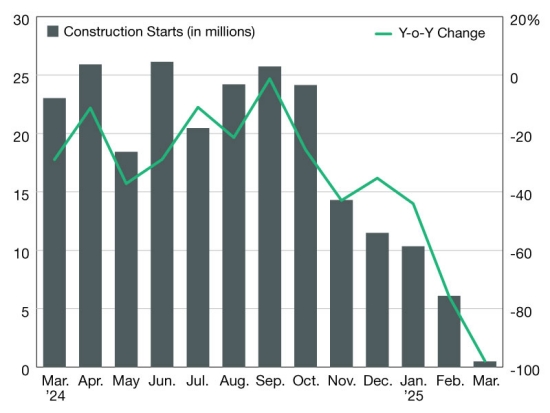
Investor Concept of the Week: Industrial Construction Starts Decline Sharply

The industrial real estate sector is experiencing a noticeable pullback in new construction. With rising interest rates and a more measured tenant demand outlook, developers are tapping the brakes—and fast. From personal discussions most of the institutions I’m talking to are passing on development over future materials price fluctuations risk attributed to the tariff and trade wars.  

Key Highlights:

  • In February 2025, new industrial construction starts totaled just 6.1 million square feet, a 75.8% drop from the same month last year.
  • January 2025 saw only 10.3 million square feet of starts, down 44% year-over-year.

This cooling in new development is setting the stage for stronger performance in existing assets, especially those in key logistics corridors.

📉 Visual Overview:

Chart of industrial construction starts in the U.S. showing monthly and year-over-year fluctuations, as per CommercialEdge data.

Source: CommercialSearch a Yardi Company

Investor Takeaway:
Reduced supply growth often leads to tighter market fundamentals. For investors, that translates to more pricing power, stronger rent growth, and better tenant retention—especially in stabilized, well-located product.

Now is the time to focus on operating assets that are positioned to benefit from this supply constraint.

Final Thoughts

Institutional capital is pouring into industrial, and the data tells a consistent story: construction is slowing, while demand remains durable. These dynamics create a sweet spot for investors with the right strategy.

At Hanson Capital, we continue to target infill industrial opportunities in supply-constrained markets like Houston, Dallas, and Phoenix—locations with real tenant demand and long-term upside.  We closed on a Houston asset 3 weeks ago and secured a contract on 3 more properties in Houston yesterday, more to come.

Categories
Real Estate

Hanson Capital Weekly Newsletter #3 – April 2–8: Market Moves & Investor Insights

Market Insights: Tariff Policies Shift Demand Within Industrial Real Estate

Recent tariff developments industrial real estate from the U.S. administration are beginning to ripple through the industrial real estate landscape. Major port markets on the East and West Coasts—including Los Angeles, New York/New Jersey, and Oakland—may experience softer demand as foreign trade volumes adjust.

At the same time, inland and strategically positioned logistics hubs like Houston are expected to remain resilient. Houston’s diversified port system, proximity to Latin American trade routes, and growing manufacturing base continue to support long-term demand.

Potential Shifts:

  • Inland Growth Corridors: Regions like Arizona, Texas, and Georgia stand to benefit from reshoring and manufacturing expansion, increasing demand for modern industrial product.
  • Supply Chain Reconfiguration: Companies are accelerating investment in distribution centers that support a mix of domestic production and nearshoring strategies.

Investor Takeaway:
While certain coastal markets may face short-term volatility, diversified logistics markets with long-term infrastructure advantages—like Houston—remain attractive. Investors should consider asset positioning within trade-resilient markets as supply chains adapt.

Sources:

Investor Concept of the Week: Why Tariff Policy Should Be on Your CRE Radar

Tariff headlines may feel like political noise, but they can directly influence tenant behavior, supply chain strategy, and ultimately property performance.

Here’s why it matters:

  • Import-dependent tenants may pause expansion or consolidate space in coastal regions facing decreased volume.
  • Domestic and nearshoring manufacturers are increasing demand for space in centrally located logistics corridors.
  • Tariffs can impact build costs, affecting the pace and feasibility of new industrial development.

Investor Move:
In a policy-driven market, strategic location matters more than ever. Look to submarkets with diversified tenant bases, lower dependency on global imports, and regional distribution advantages.

Sources:

Final Thoughts

Macro policy shifts like tariffs tend to create winners and losers in commercial real estate. The good news: we’ve built our strategy around resilient, infill industrial locations that continue to benefit from long-term trends like e-commerce, reshoring, and last-mile logistics.

At Hanson Capital, we believe now is the time to lean into markets like Houston, Phoenix, and Atlanta—where demand is sticky, supply is controlled, and tenants need space to operate regardless of what’s happening overseas.

Categories
Real Estate

Hanson Capital Weekly Newsletter #2 – March 18-25: Market Moves & Investor Insights

Market Insights: Industrial Real Estate Sector Demonstrates Resilience and Growth

The U.S. industrial real estate sector continues to showcase robust performance, with several key developments highlighting the sector’s strength:

  • Steady Transaction Volumes: In 2024, industrial property transactions totaled $69.2 billion, with properties trading at an average of $129 per square foot. Notably, Dallas-Fort Worth led the nation with nearly $6 billion in industrial sales, followed by Houston and Phoenix, each with approximately $3.4 billion in sales. (commercialedge.com)

  • Onshoring Driving Demand: The resurgence of high-tech manufacturing in the U.S. is positively impacting demand for industrial spaces. Companies are increasingly seeking facilities to accommodate production needs, leading to heightened interest in industrial real estate across various markets. (forbes.com)

  • Strategic Developments: In Laredo, Texas, Stotan Industrial has initiated construction on the Port Laredo Trade Center, a significant $100 million industrial project. Upon completion in April 2026, the center will offer 932,600 square feet of premium industrial space, enhancing Laredo’s strategic position in U.S.-Mexico trade. (lmtonline.com)

Blackstone’s Strategic Moves Signal Confidence in Industrial Real Estate

Blackstone, the world’s largest commercial property investor, has made a final bid of £489 million to acquire Warehouse REIT, a UK-based landlord with a diverse portfolio of warehouses. This offer represents a 40% premium over Warehouse REIT’s share price prior to the public takeover process. (ft.com)

What This Means:
Blackstone’s aggressive pursuit of Warehouse REIT underscores a renewed confidence in the industrial real estate sector, particularly in logistics and warehouse properties. This move aligns with a broader trend of private equity firms capitalizing on opportunities in the commercial property market, especially as valuations adjust in response to economic conditions.

Investor Takeaway:
The industrial real estate sector continues to demonstrate resilience and growth potential. Investors should consider exploring opportunities in logistics and warehouse properties, as demand remains strong and institutional interest signals a positive outlook for this asset class.

Investor Concept of the Week: Understanding Cap Rates in a Dynamic Market

The Capitalization Rate (Cap Rate) is a critical metric in real estate investment, representing the expected return on an investment property. It is calculated by dividing the property’s net operating income by its current market value.

Why Cap Rates Matter Now:

  • Market Fluctuations: As seen with recent industrial real estate activities, market dynamics can influence property valuations and, consequently, cap rates.  While cap rates have been getting larger over the last couple of years with renewed institutional activity they are compressing again, driving values up.
  • Risk Assessment: Cap rates help investors assess the risk and potential return of a property, guiding strategic investment decisions.  Remember that the risk free money is US treasuries, therefore we want to see stabilized cap rates 150-200 bps higher than treasuries to justify our investment.

Investor Move:
Regularly analyze cap rates within your target markets to identify favorable investment opportunities. Understanding the factors influencing cap rates can aid in making informed decisions and optimizing portfolio performance.

Final Thoughts

The industrial real estate sector’s ongoing resilience and strategic developments underscore its strength as an investment asset class. Blackstone’s high-stakes bid and the surge in industrial activity in key markets reinforce the attractiveness of this sector.

At Hanson Capital, we believe that targeting well-located, cash-flowing industrial assets is the right play in today’s environment. By staying informed about market trends and focusing on areas with robust growth, investors can confidently navigate the evolving landscape and capitalize on emerging opportunities.

Categories
Real Estate

Hanson Capital Weekly Newsletter #1– March 20 – 27: Market Moves & Investor Insights

Market Insights: Fed Holds Rates Steady Amid Rising Economic Uncertainty

While markets adjust to this week’s latest news and uncertainties, let’s take a quick look back at last week. Last Wednesday, the Federal Reserve announced it will be holding the federal funds rate at 4.25-4.5%—a cautious but expected move. However, the Fed lowered its forecast for GDP growth to 1.7% for the year (down from 2.1% in December) and raised its inflation outlook to 3% (up from 2%).

Key Takeaways:

  • Increased Risk of Slowdown: 18 of 19 policymakers now see increased downside risk to GDP.
  • Unemployment Concerns: 11 policymakers expect unemployment could rise to 4.5% this year.
  • Tariff Pressure: Fed Chair Jerome Powell highlighted that tariffs are driving higher inflation expectations—but said the effect may be transitory.

Market Reaction: Stocks initially surged on the news, but bond purchases also increased, signaling  a market confused with some concern about growth.

Investor Takeaway: With growth slowing and inflation still elevated, the Fed’s cautious tone signals that rate cuts may be delayed. Investors should focus on assets with strong cash flow and pricing power to weather this environment. This is ok it means we have time to accumulate deals where we can force appreciation and the eventual rate cuts will be a tailwind that we aren’t relying upon but will happily take.

Investor Concept of the Week: Stagflation – Why It Matters for Real Estate

Stagflation refers to an economic environment where growth slows, but inflation remains high—a rare but challenging scenario for investors.

Why It Matters:

  • Higher inflation increases operating costs and reduces purchasing power.
  • Slower growth pressures asset valuations and rental demand.
  • Debt costs stay high if central banks prioritize controlling inflation over stimulating growth.

Investor Move: In a stagflationary environment, look for investments in sectors with strong pricing power (e.g., industrial and essential retail) and assets with low capital expenditure needs.

Final Thoughts

While the headlines might seem uncertain, this is exactly the type of market where small-bay industrial real estate thrives. Stable cash flows, low tenant turnover, and the growing demand for last-mile logistics make this asset class resilient even when economic conditions soften.

At Hanson Capital, we’re strategically positioned to take advantage of these conditions—targeting properties where we can drive value through smart management and lease-up strategies. Economic uncertainty creates opportunity for those who know where to look.

Categories
Real Estate

Industrial Real Estate Equity in 2025: Strategic Opportunities in Shallow Bay, Multi-Tenant Assets in the U.S. Southwest

As we progress through 2025, industrial real estate continues to offer compelling equity investment opportunities. Amid a recalibration period characterized by moderated growth and shifting dynamics, Shallow Bay, Multi-Tenant industrial assets in high-growth U.S. Southwest markets are emerging as particularly attractive investment opportunities.

Market Overview

Following a period of unprecedented growth, industrial real estate experienced an adjustment in early 2025. Net absorption declined to approximately 114 million square feet, down 42% year-over-year, and vacancy rates climbed modestly to 7.0%. However, this slowdown reflects a stabilization rather than a downturn, presenting strategic opportunities to acquire assets at attractive valuations.

Investment Growth Dynamics: U.S. Southwest and Shallow Bay Industrial

The U.S. Southwest, particularly markets in Arizona, Texas, Nevada, and Southern California, has been at the forefront of industrial real estate expansion. Key factors contributing to this region’s attractiveness include:

  • Population Growth: Rapid demographic expansion and urbanization in cities like Dallas, Phoenix, Las Vegas, and Austin drive consistent demand for logistical facilities.
  • Strategic Location: Proximity to major trade corridors, ports, and Mexico enhances logistical efficiency, appealing to tenants prioritizing speed and flexibility.
  • Business-Friendly Environments: Favorable regulatory climates and lower operating costs compared to coastal markets attract diverse industries.

Unique Characteristics of Shallow Bay, Multi-Tenant Industrial Real Estate

Shallow Bay industrial properties typically feature smaller unit sizes (less than 25,000 square feet) and flexible configurations designed for multiple tenants. These facilities are uniquely positioned to benefit from current market trends:

  • Diverse Tenant Base: Multi-tenant assets provide greater risk diversification compared to single-tenant facilities, reducing exposure to vacancies and tenant turnover risks.
  • Higher Rent Growth Potential: Smaller tenants often pay higher per-square-foot rents compared to large distribution hubs, enhancing potential income streams.
  • Flexibility and Agility: These properties can quickly adapt to tenant turnover or changing market demands, crucial in markets experiencing rapid economic shifts.

Contrasting Shallow Bay vs. Traditional Industrial Assets

Compared to traditional large-scale industrial warehouses, Shallow Bay multi-tenant facilities offer distinct advantages:

  • Resilience: Less susceptibility to disruptions in single industries or tenants due to diversified tenancy.
  • Stable Occupancy Rates: Consistent demand from small and mid-sized enterprises, local businesses, and e-commerce firms maintains occupancy stability.
  • Location Advantage: Positioned closer to urban cores, these assets benefit from last-mile logistics demand, enhancing their value proposition amid growing e-commerce activities.

Strategic Investment Drivers

E-Commerce Expansion

Continued growth in e-commerce drives demand for strategically located distribution centers, particularly those capable of supporting rapid fulfillment.

Onshoring and Supply Chain Resilience

Geopolitical risks and global supply chain recalibrations encourage businesses to establish regional distribution networks closer to consumer bases, favoring Southwest U.S. markets.

Technological Integration

Advancements in automation and AI require modernized spaces. Multi-tenant facilities adaptable to technological upgrades can attract premium tenants seeking operational efficiency.

Investment Strategies

Value-Add Approaches

Targeting underperforming assets with below-market rents and short lease durations presents opportunities for repositioning and achieving enhanced rental income.

Core-Plus Investments

Acquiring stabilized Shallow Bay properties in high-demand Southwest markets provides steady cash flows with capital appreciation potential amid ongoing demand.

Development Initiatives

Reduced construction activity in 2025 enhances the attractiveness of developing Shallow Bay facilities in markets experiencing significant supply constraints and rising tenant demand.

Regional Highlights: Southwest Markets

  • Dallas-Fort Worth: Leads in industrial sales volume, bolstered by a diverse economy and sustained population influx.
  • Phoenix and Inland Empire: Attractive for ongoing industrial development, benefiting from proximity to major transport networks and rapid demographic growth.
  • Las Vegas and Reno: Emerging as key logistical hubs due to strategic positions along interstate corridors and increased demand for local distribution.

Conclusion

In 2025, equity investments in Shallow Bay, Multi-Tenant industrial properties in the U.S. Southwest offer strategic advantages, combining stability, growth potential, and resilience. At Hanson Capital, we specialize in identifying and executing opportunities within this dynamic segment to achieve strong risk-adjusted returns.

For more information about our investment opportunities, please contact us.

Sources: CBRE, CommercialEdge, NAIOP, NAR, Colliers, EQT Group


Categories
Real Estate

Hanson Capital Launches Multi-Strategy Real Estate Investment Fund

FOR IMMEDIATE RELEASE
Contact: Michael Morrison
Hanson Capital Group
406-868-9179
michael@hansonre.com

Hanson Capital Launches Multi-Strategy Real Estate Investment Fund

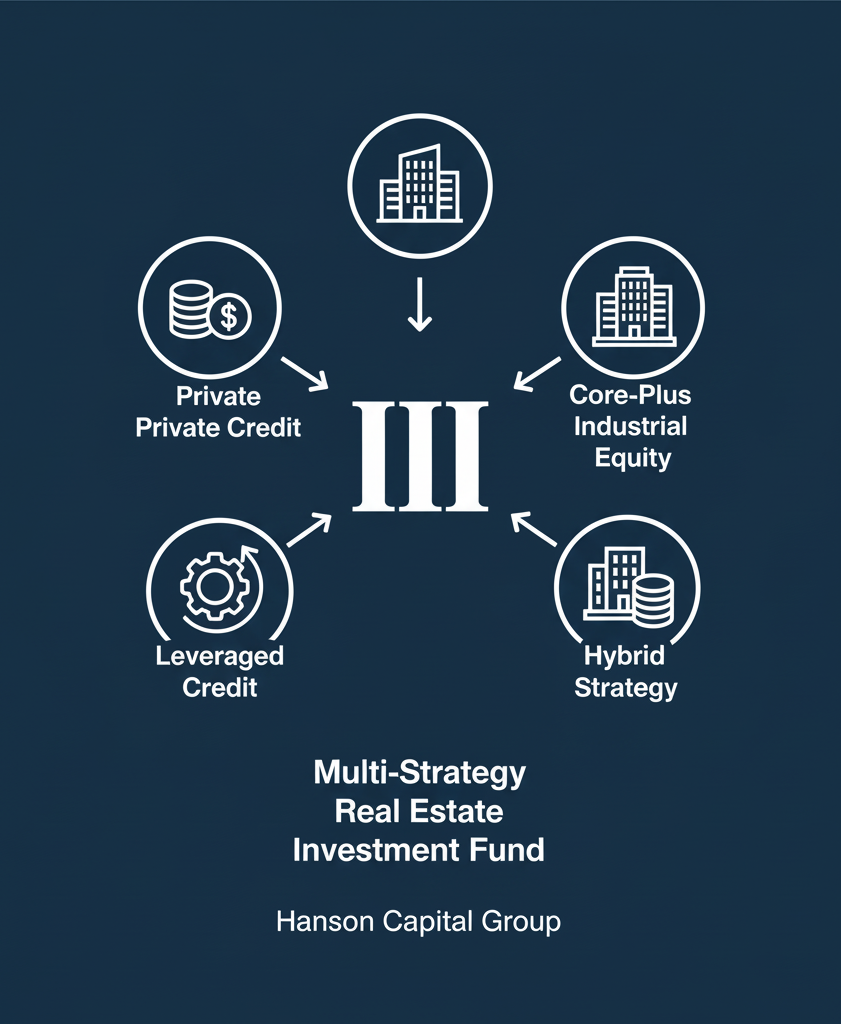
PHOENIX, Dec. 30, 2024 — Hanson Capital Group today announced the launch of Hanson Capital Opportunity Fund III, LLC, an innovative investment vehicle offering four distinct strategies within a single fund structure.

The $250 million fund provides investors the flexibility to participate in any combination of four investment strategies: core-plus equity investments in industrial properties, private credit through real estate-backed lending, leveraged credit investments, and a hybrid approach combining equity, debt, and strategic leverage.

“We’ve structured this fund to give investors precise control over their real estate investment allocation while maintaining the efficiency of a single fund vehicle,” said Chris Hanson, founder and CEO of Hanson Capital Group. “Whether an investor seeks steady income through our lending strategies, long-term appreciation through equity investments, or enhanced returns through our hybrid approach, they can customize their exposure while benefiting from our proven underwriting discipline and risk management.”

The equity strategy targets a 13% IRR through investments in industrial properties, while the private credit strategy aims to deliver 9.5% annual returns. The hybrid strategy, which combines both approaches with strategic leverage, targets a 14.5% IRR.

“Our deep experience in both lending and property acquisition has enabled us to create this innovative structure that addresses diverse investor objectives within a single fund,” said Chris Pike, Principal and Head of Debt at Hanson Capital. “By leveraging our market relationships and proven underwriting processes across multiple strategies, we’re offering institutional-quality investments with the flexibility to match individual investor goals.”

The fund will focus on opportunities throughout the Southwestern United States, where Hanson Capital currently manages $245 million in assets across 1.3 million square feet of commercial property.

About Hanson Capital Group
Founded in 2008, Hanson Capital Group is a vertically integrated real estate investment and lending firm headquartered in Phoenix, Arizona. The firm specializes in acquiring and managing commercial real estate assets and providing real estate-backed lending solutions.

Categories
Real Estate

Multi-Tenant Industrial vs. Multifamily: A Tale of Two Asset Classes

As real estate investors, we’re always searching for opportunities that combine strong fundamentals with compelling market dynamics.

Right now, we’re seeing a fascinating contrast between two traditionally reliable asset classes: multifamily housing and shallow bay industrial properties.

While multifamily has long been considered a defensive asset class, current market conditions present some challenges. According to recent data, multifamily construction hit a 50-year high in 2023, with approximately 943,000 units under construction at the end of Q3 (CBRE, 2023). This surge in supply, combined with cooling demand and rising interest rates, has led to increased vacancy rates and downward pressure on rents in many markets.

In contrast, shallow bay industrial properties – typically multi-tenant facilities with units between 1,000 to 25,000 square feet – are experiencing remarkably different dynamics. These properties currently maintain vacancy rates around 2%, less than half the average across all industrial segments. This scarcity isn’t likely to change soon, as new construction in this sector remains limited due to higher construction costs and land constraints in prime infill locations.

The fundamentals supporting shallow bay industrial are particularly compelling:

  1. Tenant Diversification: Unlike multifamily properties which often face concentrated move-out periods, shallow bay industrial typically houses diverse businesses with staggered lease terms, providing more stable cash flow and reduced vacancy risk.
  2. Rising Demand: The explosion of e-commerce and last-mile delivery needs continues to drive demand for these smaller, strategically located spaces. Research indicates that last-mile delivery demand is projected to increase 78% globally by 2030.
  3. Limited New Supply: While multifamily is experiencing significant new inventory, shallow bay industrial remains underbuilt. Many existing properties are actually being redeveloped for other uses, further constraining supply.
  4. Rent Growth Potential: Many shallow bay properties are owned by longtime holders who haven’t kept pace with market rates, creating opportunities for meaningful NOI growth through strategic repositioning and professional management.

What makes this particularly interesting is the timing. As the Federal Reserve continues to make rate cuts into 2025, real estate values broadly should benefit from cap rate compression. However, shallow bay industrial stands to gain additional appreciation from the strong supply-demand imbalance and operational upside potential.

This isn’t just theoretical – we’ve seen it firsthand. In a recent Phoenix project, we were able to create over $10 million in value in just 24 months through strategic improvements and bringing rents to market rates, even during a challenging interest rate environment.

While multifamily will undoubtedly remain a crucial part of many investment portfolios, current market conditions suggest shallow bay industrial may offer superior risk-adjusted returns for investors seeking both stability and growth potential. The key is finding properties with the right fundamentals in markets with strong demographic and economic tailwinds.

*Sources: CBRE Research Q3 2023, World Economic Forum, Cushman & Wakefield Industrial MarketBeat Q4 2023*