Categories
Real Estate

Hanson Capital Launches Multi-Strategy Real Estate Investment Fund

FOR IMMEDIATE RELEASE
Contact: Michael Morrison
Hanson Capital Group
406-868-9179
michael@hansonre.com

Hanson Capital Launches Multi-Strategy Real Estate Investment Fund

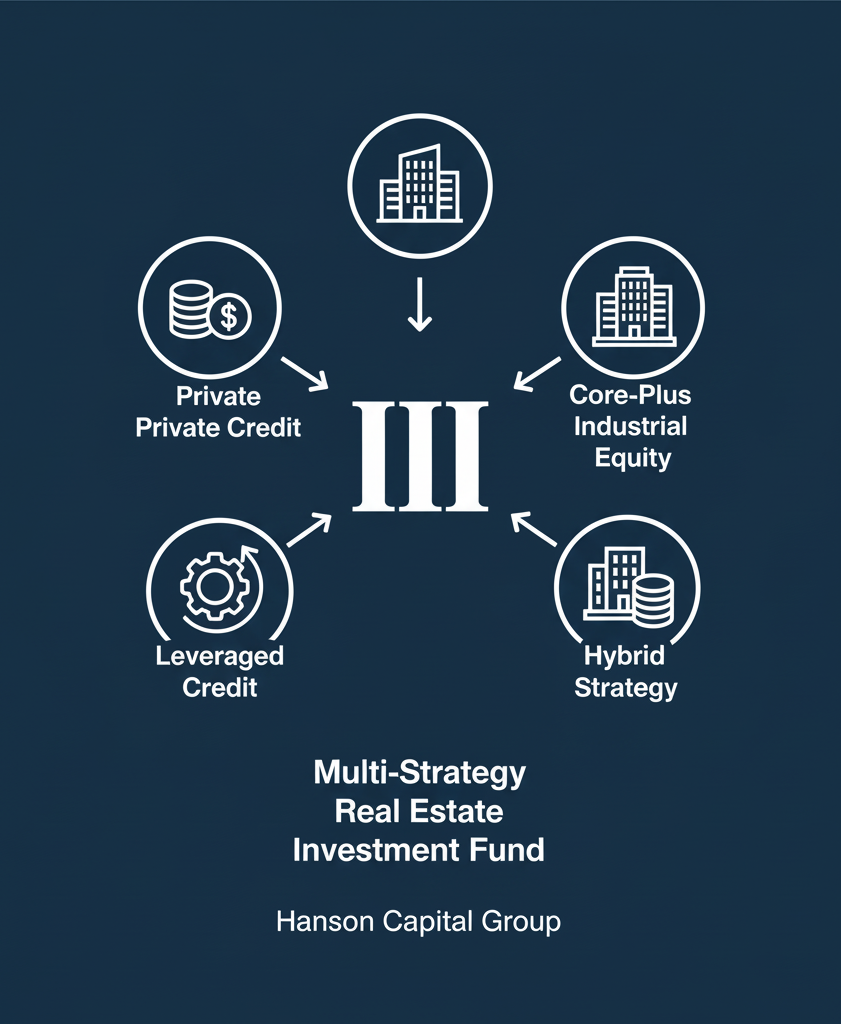
PHOENIX, Dec. 30, 2024 — Hanson Capital Group today announced the launch of Hanson Capital Opportunity Fund III, LLC, an innovative investment vehicle offering four distinct strategies within a single fund structure.

The $250 million fund provides investors the flexibility to participate in any combination of four investment strategies: core-plus equity investments in industrial properties, private credit through real estate-backed lending, leveraged credit investments, and a hybrid approach combining equity, debt, and strategic leverage.

“We’ve structured this fund to give investors precise control over their real estate investment allocation while maintaining the efficiency of a single fund vehicle,” said Chris Hanson, founder and CEO of Hanson Capital Group. “Whether an investor seeks steady income through our lending strategies, long-term appreciation through equity investments, or enhanced returns through our hybrid approach, they can customize their exposure while benefiting from our proven underwriting discipline and risk management.”

The equity strategy targets a 13% IRR through investments in industrial properties, while the private credit strategy aims to deliver 9.5% annual returns. The hybrid strategy, which combines both approaches with strategic leverage, targets a 14.5% IRR.

“Our deep experience in both lending and property acquisition has enabled us to create this innovative structure that addresses diverse investor objectives within a single fund,” said Chris Pike, Principal and Head of Debt at Hanson Capital. “By leveraging our market relationships and proven underwriting processes across multiple strategies, we’re offering institutional-quality investments with the flexibility to match individual investor goals.”

The fund will focus on opportunities throughout the Southwestern United States, where Hanson Capital currently manages $245 million in assets across 1.3 million square feet of commercial property.

About Hanson Capital Group
Founded in 2008, Hanson Capital Group is a vertically integrated real estate investment and lending firm headquartered in Phoenix, Arizona. The firm specializes in acquiring and managing commercial real estate assets and providing real estate-backed lending solutions.

Categories
Real Estate

Multi-Tenant Industrial vs. Multifamily: A Tale of Two Asset Classes

As real estate investors, we’re always searching for opportunities that combine strong fundamentals with compelling market dynamics.

Right now, we’re seeing a fascinating contrast between two traditionally reliable asset classes: multifamily housing and shallow bay industrial properties.

While multifamily has long been considered a defensive asset class, current market conditions present some challenges. According to recent data, multifamily construction hit a 50-year high in 2023, with approximately 943,000 units under construction at the end of Q3 (CBRE, 2023). This surge in supply, combined with cooling demand and rising interest rates, has led to increased vacancy rates and downward pressure on rents in many markets.

In contrast, shallow bay industrial properties – typically multi-tenant facilities with units between 1,000 to 25,000 square feet – are experiencing remarkably different dynamics. These properties currently maintain vacancy rates around 2%, less than half the average across all industrial segments. This scarcity isn’t likely to change soon, as new construction in this sector remains limited due to higher construction costs and land constraints in prime infill locations.

The fundamentals supporting shallow bay industrial are particularly compelling:

  1. Tenant Diversification: Unlike multifamily properties which often face concentrated move-out periods, shallow bay industrial typically houses diverse businesses with staggered lease terms, providing more stable cash flow and reduced vacancy risk.
  2. Rising Demand: The explosion of e-commerce and last-mile delivery needs continues to drive demand for these smaller, strategically located spaces. Research indicates that last-mile delivery demand is projected to increase 78% globally by 2030.
  3. Limited New Supply: While multifamily is experiencing significant new inventory, shallow bay industrial remains underbuilt. Many existing properties are actually being redeveloped for other uses, further constraining supply.
  4. Rent Growth Potential: Many shallow bay properties are owned by longtime holders who haven’t kept pace with market rates, creating opportunities for meaningful NOI growth through strategic repositioning and professional management.

What makes this particularly interesting is the timing. As the Federal Reserve continues to make rate cuts into 2025, real estate values broadly should benefit from cap rate compression. However, shallow bay industrial stands to gain additional appreciation from the strong supply-demand imbalance and operational upside potential.

This isn’t just theoretical – we’ve seen it firsthand. In a recent Phoenix project, we were able to create over $10 million in value in just 24 months through strategic improvements and bringing rents to market rates, even during a challenging interest rate environment.

While multifamily will undoubtedly remain a crucial part of many investment portfolios, current market conditions suggest shallow bay industrial may offer superior risk-adjusted returns for investors seeking both stability and growth potential. The key is finding properties with the right fundamentals in markets with strong demographic and economic tailwinds.

*Sources: CBRE Research Q3 2023, World Economic Forum, Cushman & Wakefield Industrial MarketBeat Q4 2023*

Categories
Investing

Construction Loan Outline

A construction loan is a short-term loan that is used to finance the cost of building or remodeling a home. These loans typically have higher interest rates and require the borrower to provide a detailed plan of the construction project, including the cost of materials and labor, before the loan can be approved.

Here is an outline of key points about construction loans:

  1. Purpose: financing the cost of building or remodeling a home
  2. Term: short-term (typically 12 months or less)
  3. Interest rate: typically higher than traditional mortgages
  4. Borrower requirements: detailed construction plan, including cost estimates
  5. Repayment: usually made in draws as the construction progresses
  6. Collateral: the land and the unfinished home
  7. Typically the lender will require inspections at key points of the construction to release funds.
  8. Once the construction is complete, the borrower may refinance the construction loan into a permanent mortgage.

Please note that these are general points and the specific terms and requirements of a construction loan may vary depending on the lender and the borrower’s credit history and financial situation.

Lorem Ipsum

Please note that these are general points and the specific terms and requirements of a construction loan may vary depending on the lender and the borrower's credit history and financial situation. It is always recommended to consult with a lender before taking a loan.
  1. Purpose: The main purpose of a construction loan is to provide the borrower with the necessary funds to build or remodel a home. This can include purchasing the land, paying for architectural and engineering plans, and covering the cost of materials and labor.
  2. Term: Construction loans are typically short-term loans, with a term of 12 months or less. This is because the construction project is usually completed within a year, and the loan is intended to be paid off as the construction progresses.
  3. Interest rate: Construction loans often have higher interest rates than traditional mortgages because they are considered to be higher risk. The lender is taking on the risk of the construction project and the borrower’s ability to repay the loan, so they may charge a higher rate to compensate for that risk.
  4. Borrower requirements: To be approved for a construction loan, the borrower will typically need to provide a detailed construction plan, including cost estimates for the materials and labor required for the project. They may also need to provide proof of income, credit history, and other financial information.
  5. Repayment: Construction loans are usually repaid in “draws” as the construction progresses. This means that the lender will release funds to the borrower in stages, typically after inspections have been completed to ensure that the work is progressing as planned.
  6. Collateral: The collateral for a construction loan is typically the land and the unfinished home. This means that if the borrower is unable to repay the loan, the lender can foreclose on the property and take ownership of it.
  7. Inspections: Lenders typically require inspections at key points of the construction process to ensure that the work is progressing as planned and to release funds for the next stage of the project. This can include inspections at the foundation, framing, and final stages of construction.
  8. Refinancing: Once the construction is complete, the borrower may refinance the construction loan into a permanent mortgage. This allows them to convert the short-term construction loan into a longer-term loan with a lower interest rate, making it more affordable to repay over time.

Please note that these are general points and the specific terms and requirements of a construction loan may vary depending on the lender and the borrower’s credit history and financial situation. It is always recommended to consult with a lender before taking a loan.

Categories
Investing Private Credit

The Smart Money’s Secret: Why Savvy Investors Love Private Credit

Let’s talk about one of the best-kept secrets in investing: private credit. While you may be concentrating (like most investors) on publicly traded stocks and bonds, many sophisticated investors are discovering that private credit can be a game-changer for their portfolios. Here’s why – and what you need to know to get in on the action.

Think of Private Credit as Your Portfolio’s Secret Weapon

Imagine lending money to experienced real estate developers who are buying or renovating properties. These loans are secured by real estate – actual buildings and land you can walk on – not just paper promises. When done right, you can earn solid monthly income while having real assets backing your investment. Pretty cool, right?

The best part? While the stock market is riding its emotional roller coaster, private credit just keeps churning out monthly payments. And those payments are typically way better than what you’d get from traditional fixed-income investments. We’re talking potential returns of 8-12% annually. Not too shabby.

Interested in this opportunity?

Want to learn more? Let's talk about how private credit could work for you.

What Separates the Best from the Rest

Here’s the thing though – not all private lenders are created equal. You want someone who’s been in the trenches and knows how to protect your money. Here’s what to look for:

Smart Risk Management

  • They won’t lend more than 65-75% of a property’s value (this is your safety cushion)
  • They do their homework on borrowers (no tire-kickers allowed)
  • They watch projects like a hawk and release funds based on progress
  • They have a game plan for when things don’t go as planned (because sometimes they don’t)

Real Experience

  • They’ve seen good markets and bad (and lived to tell about it)
  • They’re transparent about their track record
  • They’ve dealt with problem loans successfully
  • The good borrowers keep coming back to them

The Right Stuff

  • They see tons of deals but only pick the best ones
  • They have a proven process for evaluating opportunities
  • They know their market cold
  • They’re not afraid to say “no” to iffy deals

Here’s a pro tip: Look for a lender who puts their own money into deals alongside yours. There’s nothing like having skin in the game to focus someone’s attention!

Is Private Credit Right for You?

Private credit isn’t for everyone. You typically need to leave your money in for at least 6-24 months, sometimes longer. But if you’re an accredited investor looking for steady income backed by real assets, this could be your sweet spot.

Think about it: While your neighbors are stressing about market swings, you could be collecting regular monthly checks backed by actual properties. The key is finding the right partner – someone who combines deep expertise with a disciplined approach and always puts investors first.

Remember: In private credit, boring is beautiful. You want a partner who’s methodical, careful, and has a proven system for protecting your capital while delivering solid returns. They might not be the flashiest player in town, but they’ll help you sleep better at night.

The Bottom Line

Private credit can be a fantastic addition to your investment mix – if you do it right. Look for a partner with the expertise to find great deals, the discipline to manage risk, and the track record to prove they know what they’re doing. Your portfolio will thank you.

Want to learn more? Let’s talk about how private credit could work for you.