Categories
Real Estate

WSJ: Private Credit Enters 2026 on Firm Footing

Monroe Capital began 2026 by closing a $6.1 billion private credit fund focused on direct lending to middle-market companies. While large raises in this space are no longer unusual, the size and timing of this fund—early in the year and amid lingering macro uncertainty—underscore the durability of institutional demand for private credit. The close follows several years of strong fundraising across the asset class and reinforces its role as a permanent fixture in institutional portfolios.

Our Take

Rather than signaling something new, this development highlights how private credit continues to mature and entrench itself within the broader capital markets. Banks’ reduced appetite for middle-market and asset-backed lending has persisted for years, shaped by post-crisis regulation and balance-sheet constraints. Private credit managers have filled that gap, and investors now view the strategy less as an alternative and more as a core income-oriented allocation alongside traditional fixed income.

For investors, the key implications lie in how scale and competition are reshaping return dynamics. As capital continues to flow into established managers, deal competition has intensified. This does not eliminate opportunity, but it places greater emphasis on underwriting discipline, structural protections, and sector selection. Returns are increasingly driven by manager skill rather than broad market conditions, particularly as lenders navigate refinancing risk, borrower leverage, and uneven operating fundamentals across industries.

The growth of private credit also has knock-on effects for commercial real estate and other private-market borrowers. With banks remaining cautious, private lenders are often the most reliable source of capital for refinancings and transitional assets. At the same time, higher interest rates mean that access to capital does not equate to cheap capital, reinforcing the importance of realistic cash-flow assumptions and conservative leverage.

In that context, Monroe Capital’s fundraise serves as a reminder that private credit’s relevance is enduring, not cyclical. The opportunity set remains attractive, but success in the next phase of the cycle will depend less on the asset class itself and more on execution, selectivity, and risk management.

Source: Monroe Capital Starts Year With New $6.1 Billion Private Credit Haul

If you’re curious about how our approach could fit into your portfolio, visit our website or schedule a call to connect with our team. We’d love to talk through what we’re seeing and where we’re going next.

Categories
Real Estate

Fed signaling: “more cuts could come in 2026,” but the path looks contested

Recent Federal Reserve meeting minutes indicate that while policymakers still expect interest rate cuts in 2026, there is growing disagreement about the pace, timing, and conditions under which those cuts should occur. Several officials emphasized that inflation progress remains uneven and that policy may need to stay restrictive longer than markets expect, while others signaled openness to easing if economic momentum cools. The result is a Fed that is directionally dovish over the long term, but far less unified in the near term. This implies a slower, less predictable path for rates.

Our Take

For private market investors, the key takeaway is not simply that cuts are coming, but that rate uncertainty is likely to persist. This matters because many underwriting assumptions, especially in private credit and commercial real estate, implicitly rely on a smooth decline in borrowing costs. The Fed’s internal divisions suggest that outcome is far from guaranteed.

In practical terms, a choppier rate path reinforces the importance of margin of safety. In private credit, tighter spreads and abundant capital have already compressed risk-adjusted returns. If base rates remain higher for longer or fluctuate more than expected, borrowers with thin cash flow cushions may face stress sooner, particularly those relying on refinancing rather than amortization. This environment favors lenders who emphasize conservative leverage, strong covenants, and borrowers with durable demand and strong track records.

For commercial real estate, especially long-duration assets like industrial portfolios with extended lease terms, rate volatility complicates valuation. Cap rates tend to adjust more slowly than financing costs, which can pressure values if long-term rates remain elevated. Investors may increasingly prioritize assets with near-term rent growth, shorter lease durations, or built-in inflation protection, rather than relying solely on financial engineering or future rate relief.

More broadly, the Fed’s lack of consensus signals a shift away from the post-2020 mindset that policy changes will be swift and predictable. For private market investors, this argues for underwriting that assumes higher-for-longer uncertainty, even if the eventual destination for rates is lower. Returns may still be attractive, but they will be earned through disciplined structure and asset selection, not broad multiple expansion.

In short, the Fed’s message is less about imminent easing and more about caution. Investors who recalibrate expectations accordingly, stress-testing deals for delayed or uneven cuts, are likely to be better positioned in 2026 and beyond.

Source: Fed Officials Signal More Cuts Could Come in 2026: Minutes

Categories
Real Estate

Inflation Is Cooling, but Signals Remain Mixed

Each week, we spotlight a compelling article that highlights a key development or data point shaping private credit, commercial real estate (with a focus on industrial), or the broader macroeconomic landscape. We accompany it with our perspective on its implications for our investment strategy and the markets we serve. 

Reuters: Inflation Is Cooling, but Signals Remain Mixed

The U.S. government’s November inflation report showed that overall inflation continued to slow, with prices rising 2.7% compared to a year ago, down from earlier in the fall. Inflation excluding food and energy also eased modestly. However, the report comes with an important caveat: recent government shutdowns disrupted data collection, meaning some of the numbers may not fully capture real-time conditions. One area that remains elevated at the national level is housing-related inflation, which reflects longer-term averages rather than current market rents.

Our Take

Lower inflation is generally a positive backdrop for investors, as it reduces pressure on interest rates and helps stabilize long-term asset values. That said, this report reinforces an important distinction between headline economic data and what investors are experiencing on the ground.

National inflation measures for housing tend to lag actual market conditions, often by several quarters. As a result, while government data still shows elevated housing inflation, many real estate markets, including parts of the multifamily sector, are already experiencing slower rent growth or outright rent declines. This divergence helps explain why inflation statistics can appear stronger than current operating results.

For apartment investors, this dynamic matters. Declining or flat rents can pressure near-term cash flow even as broader inflation appears contained. That puts more weight on expense control, tenant retention, and conservative assumptions around rent growth in underwriting. It also underscores why asset-level performance should not be evaluated solely through the lens of macro data.

From a financing perspective, uncertainty around inflation data may keep interest rates higher for longer than many expect. Policymakers are unlikely to react aggressively to a single report that may be incomplete, which means borrowers should continue to plan for stable-to-elevated financing costs rather than rapid rate relief.

The broader takeaway is that this is a transitional phase. Inflation is cooling, but not uniformly. Investors are best positioned by focusing on assets with durable demand, realistic rent assumptions, and sufficient cushion to perform even in a slower rental environment.

Source: Consumer Price Index News Release
Categories
Real Estate

Reuters: China’s Growth Softness Re-Emerges

According to a recent article from Reuters, new economic data from China show that growth remains under pressure, with weaker consumer spending, slower industrial activity, and ongoing problems in the property sector. While Chinese policymakers have taken steps to support the economy, investors remain skeptical that these measures are enough to meaningfully improve confidence or stabilize real estate. As a result, expectations for China’s near-term growth—and its contribution to global demand—have been revised lower.

Our Take

For investors, China’s renewed slowdown is important not as a short-term headline, but as part of a broader global shift that has been unfolding for several years. For a long time, global markets benefited from China acting as a steady engine of growth—supporting manufacturing, trade, and commodity demand. That role has weakened, and the latest data reinforce the idea that China is unlikely to provide the same economic lift it once did.

In industrial real estate, the impact is mixed. On one hand, slower growth in China can reduce global trade volumes, which affects shipping, ports, and certain logistics hubs tied closely to international commerce. On the other hand, many positive trends in U.S. industrial real estate—such as nearshoring, domestic manufacturing investment, and the need for faster delivery—are driven more by structural changes than by overseas demand. This suggests that newer, well-located industrial assets serving domestic users remain well positioned, while older or trade-dependent facilities may face more pressure.

For private credit investors, China’s ongoing property stress serves as a reminder that highly leveraged markets can take years to fully work through their challenges. While U.S. private credit has limited direct exposure to China, periods of global uncertainty often affect investor sentiment, liquidity, and risk pricing more broadly. In these environments, loans with conservative leverage, strong collateral, and clear downside protection tend to perform better than those relying mainly on higher yields.

From a valuation standpoint, slower global growth can eventually support lower interest rates, but that alone does not guarantee strong returns. Cash-flow durability and tenant or borrower quality matter more when economic growth is less certain. Assumptions around rent growth, exit pricing, and refinancing should remain grounded rather than optimistic.

Overall, China’s softer outlook reinforces a key theme for private market investors today: returns are likely to come from careful asset selection, disciplined underwriting, and risk management—not from relying on broad economic tailwinds.

Source: China’s economy stalls in November as calls grow for reform

If you’re curious about how our approach could fit into your portfolio, visit our website or schedule a call to connect with our team. We’d love to talk through what we’re seeing and where we’re going next.

Categories
Real Estate

Reuters: Rate Cuts May Come, But the Path Is Less Certain

A recent Reuters report highlights a key market tension heading into the Fed’s next decision: while investors are focused on what happens at the upcoming meeting, there is growing uncertainty about how many rate cuts the market should expect in 2026. Reuters frames this as a shift from debating whether cuts are coming to debating how far they go, with implications for how markets price risk and growth going forward.

Our Take

For private-market investors, this matters because many valuations and underwriting models have quietly assumed that “rates will drift down” in a smooth, reliable tailwind. If the path of cuts in 2026 is less certain, then the “easy” part of the story goes away, and fundamentals matter more. In commercial real estate, asset values are heavily influenced by long-term rates because they shape financing costs and the return investors demand. When the market becomes less confident about the rate path, buyers often become more selective, and pricing tends to rely more on in-place income and realistic rent growth, not optimistic assumptions about cap rates falling.

In private credit, the rate outlook affects both return potential and borrower stress. If rates fall less than expected, many borrowers will not get the payment relief they were counting on. That keeps pressure on companies with tighter margins, weaker pricing power, or high leverage. At the same time, if rates do fall but more slowly, lenders may still earn attractive yields, but they should not assume credit risk automatically improves. The right question becomes: does this borrower have enough cash flow stability to handle multiple scenarios, including a “higher for longer” case?

From a risk and reward perspective, this kind of uncertainty usually increases the value of conservative structuring. For credit, that means stronger lender protections, realistic leverage, and a real focus on liquidity. For real estate, it means underwriting to sustainable cash flow, tenant quality, and rollover risk, with less reliance on rate-driven value recovery. In short, when the rate path is less predictable, disciplined underwriting becomes a bigger part of performance.

Source: Wall St mixed ahead of Fed verdict as doubts grow over 2026 cuts

If you’re curious about how our approach could fit into your portfolio, visit our website or schedule a call to connect with our team. We’d love to talk through what we’re seeing and where we’re going next.

Categories
Real Estate

Small-Bay Industrial: Why the Overlooked Middle of the Market Deserves Your Attention

When most investors think about industrial real estate, they picture Amazon fulfillment centers or massive warehouses and distribution facilities serving national supply chains. While those assets dominate media headlines, there’s a different conversation happening among more sophisticated operators who’ve spent time in secondary markets and infill neighborhoods. It’s about a segment that doesn’t make the news, rarely gets analyzed by the big banks, and until recently traded at a discount because it seemed too difficult to scale: multi-tenant industrial properties with unit sizes between 2,000 and 10,000 square feet.

These aren’t the buildings you see from the highway. They’re the ones tucked into the heart of local city centers—home to local contractors, small distributors, repair shops, and the kinds of businesses that keep a metro area functioning. Call them small-bay industrial properties, service-industrial, or shallow-bay real estate. Whatever the label, they’ve quietly become one of the most compelling plays in PERE.

The Fundamentals Tell a Clear Story

Here’s what caught our attention: while big-box warehouse vacancy rates have climbed into the 10% range—driven by a construction boom that overshot demand—small-bay properties are running at a much more modest 3% to 4%, and it’s not a fluke.

The gap exists because the supply and demand dynamics in this segment are fundamentally different. On the supply side, almost nothing new is being built due to developable infill land being nearly nonexistent, expensive, and hard to entitle.  Developers who can secure these prime pieces of land would rather build apartments or retail because the per-unit or per-square-foot returns are higher (which helps justify paying the higher land prices). Even when industrial zoning exists, most developers chase larger single-tenant opportunities that are easier to finance, manage, and ultimately sell to institutional buyers. These supply constraints are producing negligible new small-bay construction nationwide.

On the demand side, the tenant base is anchored by businesses that need to be close to their customers. Unlike the logistics companies and national retailers who lease big-box space in secondary and tertiary areas, small-bay industrial tenants, like your local plumbing company, can’t operate profitably out of a warehouse 40 miles from its service area. These businesses need space within minutes of their job sites, which creates demand that’s both persistent and geographically constrained.

Lease rates reflect this supply and demand imbalance. Small-bay industrial lease rates per square foot frequently exceed those of larger warehouses, sometimes by 30% or more. Tenants aren’t just paying for space—they’re paying for location. And because most of these businesses generate revenue by serving the local economy, their willingness to pay holds up across market cycles.

Resilience Comes from Diversification and Necessity

One of the underappreciated strengths of small-bay industrial is found in the tenant diversification associated with these opportunities. A typical small-bay industrial property might have 20 or 30 tenants, each occupying 3,000 to 8,000 square feet, with no single tenant accounting for more than 5% of revenue. If one of these tenants leaves, the impact is minimal, and, in most markets, the vacancy is absorbed quickly due to the demand factors discussed before.

The tenant mix is another strength of small-bay industrial. Tenants at these properties aren’t speculative startups or businesses riding macro trends. They’re everyday HVAC contractors, cabinet manufacturers, wholesale distributors, electrical contractors, and similar businesses that provide essential services that don’t go away when the economy softens. Their revenue is tied primarily to local population and business activity, which means as long as people live and work in the area, demand for their services (and the space they operate from) remains stable.

We’ve seen this play out in real time. During the pandemic, when e-commerce demand surged, small-bay properties filled up almost overnight as delivery services and small-scale fulfillment operations scrambled for space. When that wave receded and some of those tenants downsized, the units were quickly backfilled by trade contractors and local distributors who’d been priced out during the boom. The underlying demand didn’t disappear—it just shifted, which is exactly what diversification is supposed to protect against.

Tenant retention in this segment of industrial real estate tends to be very high because of how disruptive relocation is for these types of tenants.  For most of these tenants, relocating means downtime, lost customer access, and the risk of losing employees who can’t commute to a new location. That level of disruption leads tenants to renew, often at the new and higher market rents, because the alternative is cost prohibitive.

Fragmentation Creates Opportunity for Disciplined Capital

For all its strengths, small-bay industrial has historically been inefficient. Ownership tends to be fragmented across local operators, family offices, and individual investors. Many properties were built in the 1970s or 80s and have been held for decades with minimal reinvestment or capital improvements. The lack of reinvestment leads to peeling paint, outdated spaces, tenants on month-to-month leases paying below-market rents, and property management that’s reactive at best.

That inefficiency is an opportunity. For savvy, experienced investors, the playbook is straightforward: acquire at a basis that’s well below replacement cost, invest in eliminating deferred maintenance and performing exterior upgrades, professionalize the leasing and management, and drive NOI through a combination of rent growth and occupancy gains.

The strategy isn’t speculative and comes down to executing simple blocking and tackling for experienced investors. Repaint the building, upgrade the landscaping, add LED lighting, and renovate a few office suites. Convert gross leases to triple-net where possible. Renew existing tenants while right-sizing their rental rates to align with the market. Bring in a property manager who actually responds quickly to tenant requests. These simple moves bring the properties up to a standard that attracts institutional buyers.

Why We’re Focused Here

At Hanson Capital, our interest in small-bay industrial investments grew out of observing firsthand what actually performs across market cycles. When we looked at assets that maintained occupancy, delivered consistent cash flow, and appreciated steadily without relying on market timing or leverage, small-bay kept showing up.

The segment aligns with how we think about risk. We’d rather own an asset with 25 tenants in a supply-constrained market and where demand is eager to absorb any unanticipated vacancy than a single-tenant warehouse where one lease expiration or credit event can become catastrophic. We’d rather compete in markets where new construction is structurally limited than in ones where another million square feet can break ground on a moment’s notice.

Our approach is to target infill properties in metros with strong population and employment growth, where land is scarce, zoning is restrictive, and demand from small businesses is durable. We look for assets that are fundamentally well located but operationally underperforming, where a defined capital plan and hands-on management can unlock value. The goal isn’t to flip properties.  It’s to reposition them into stabilized, income-producing assets that justify institutional pricing when the time comes to exit.

Small-bay industrial won’t be the highest-returning sector in every vintage. But for investors seeking a combination of downside protection, income stability, and appreciation driven by fundamentals rather than speculation, it’s worth serious consideration. The opportunity is real, the market is inefficient, and the tailwinds of undersupply, tenant diversity, and infill scarcity are not going away.

Sources include third-party data from CBRE, Green Street, NAIOP, MSCI, and Preqin.

If you’re curious about how our approach could fit into your portfolio, visit our website or schedule a call to connect with our team. We’d love to talk through what we’re seeing and where we’re going next.

Categories
Real Estate

ADP: U.S. Private Employers Shed Jobs in November

U.S. private employers cut 32,000 jobs in November 2025, according to ADP—a notable miss versus expectations. The weakness was most pronounced at small businesses (under 50 employees), and job declines showed up in construction and manufacturing. Wage growth also eased slightly compared with the prior month.

Our Take

For private-market investors, the main point is that this report reinforces a trend we’ve been watching: the labor market is gradually cooling, and the pressure appears most visible in parts of the economy that are typically more sensitive to tighter credit and higher borrowing costs. Small businesses often feel a slowdown first because they have less flexibility in margins and financing. When hiring turns into headcount reduction, it can be a useful indicator that growth is becoming harder to sustain in the “everyday economy”—a dynamic that can eventually influence spending, investment, and borrower performance.

From a pricing perspective, a softer employment backdrop can work in two directions. On the supportive side, cooling labor conditions can strengthen the case that inflation pressures will continue to ease, which may help interest rates trend lower over time. That would generally improve financing math and support values across private assets. On the cautionary side, slower growth can also lead to more conservative lending, less aggressive valuations, and a higher bar for underwriting—especially for strategies dependent on near-term refinancing or rapid rent growth.

In private credit, this environment typically pushes underwriting toward “defense.” Lenders focus more on durable, in-place cash flow, lower leverage, and stronger lender protections (tighter covenants, stricter add-back standards, and more conservative base cases). Dispersion also tends to increase: higher-quality borrowers still attract capital, while weaker credits face repricing and fewer options.

For industrial real estate, a moderating labor backdrop is best viewed as a call for precision, not pessimism. Demand drivers like logistics efficiency, inventory strategy, and ongoing supply-chain reconfiguration can remain supportive even in a slower-growth environment. The practical approach is to emphasize properties and markets where fundamentals are most durable—high-function buildings, infill locations, strong tenant credit, and limited near-term competitive supply—while staying realistic on rent growth in submarkets with heavier deliveries. Overall, this trend backdrop can actually create opportunity: as some participants pull back, disciplined buyers and lenders are often able to be more selective, improve structure, and target higher-quality risk-adjusted returns.

Source: ADP reports decline of 32,000 private sector jobs in November

If you’re curious about how our approach could fit into your portfolio, visit our website or schedule a call to connect with our team. We’d love to talk through what we’re seeing and where we’re going next.

Categories
Real Estate

Fed Signals Possible Rate Cut, but Policymakers Are Split

New York Fed President John Williams said on November 21 that the central bank could consider cutting interest rates in the near term without risking progress on inflation. He pointed to a cooling job market and financial conditions that remain tight enough to keep price pressures moving lower. His remarks pushed market expectations for a December rate cut to roughly 60 percent. However, not all Fed officials share his view. Leaders such as Susan Collins and Lorie Logan warned that cutting rates too early could allow inflation to flare up again or encourage too much risk-taking in financial markets. As a result, the Fed appears divided, and the direction of interest rates heading into 2026 is still uncertain.

Our Take

For investors, this mixed messaging matters. Williams’ comments suggest the Fed believes interest rates are high enough to slow the economy gradually without causing a sharp downturn. That means rate cuts are likely on the horizon, but the timing is unclear. Borrowers would benefit if cuts happen sooner, but investors should avoid assuming that relief will arrive quickly or predictably. The disagreement inside the Fed highlights the competing pressures officials are managing at the same time: slowing inflation, moderating economic growth, and the risk of creating instability if policy changes too quickly.

In private credit, this environment supports a steady and disciplined approach. If rates begin to move lower, yields on new loans may decline as interest spreads narrow. This makes careful deal selection even more important, with a greater focus on strong fundamentals rather than reaching for higher returns. If rate cuts take longer to materialize, higher borrowing costs will continue to pressure sponsors with weaker cash flow, which increases the value of lender protections and collateral strength.

For commercial real estate, including industrial assets, the takeaway is similar. With potential rate cuts but no guaranteed timeline, investors should continue using conservative assumptions for exit cap rates and refinancing conditions. The current backdrop rewards properties with reliable tenants, stable cash flow, and locations with consistent demand. Williams’ comments indicate that policy may shift in a friendlier direction over time, but it will likely happen gradually and with meaningful uncertainty along the way.

Source: Williams’ comments boost odds of a Fed cut, though policy hawks remain adamant

If you’re curious about how our approach could fit into your portfolio, visit our website or schedule a call to connect with our team. We’d love to talk through what we’re seeing and where we’re going next.

Categories
Real Estate

Banks Take a Breather: Credit Stays Tight but Steady

The Federal Reserve’s October 2025 Senior Loan Officer Opinion Survey found that banks kept their commercial real estate (CRE) lending standards largely unchanged during the third quarter. After more than a year of tightening credit, the tone has shifted from restrictive to steady. Loan demand picked up slightly, especially for well-leased and income-producing properties, while commercial and industrial (C&I) lending remained tighter. In short, the Fed’s survey suggests that while credit conditions aren’t getting worse, banks are still far from reopening the lending spigot.

Our Take

This survey provides a useful temperature check on the private markets. The key takeaway is that credit availability has stabilized but remains disciplined. Banks appear comfortable with current risk levels but unwilling to stretch on leverage or pricing. For investors, that stability can actually be constructive—it creates a more predictable playing field after several volatile quarters and keeps speculative excess in check.

For commercial real estate, and particularly the industrial sector, this environment rewards investors who focus on quality, not financial engineering. With debt still expensive and proceeds conservative, property values will depend more on steady income growth than on cheap leverage. In other words, cap rates are unlikely to compress meaningfully until credit loosens or rates fall, so underwriting should continue to assume normalized (not boom-era) returns.

Private credit managers stand to benefit most from this middle ground. As banks stay cautious, non-bank lenders retain strong pricing power and can target solid risk-adjusted yields with better collateral and structure. However, discipline remains essential. Borrowers facing refinancing pressure will increase deal flow, but not all of it will deserve capital. Strong sponsors with proven assets—especially in logistics and light industrial—should command attention, while transitional or over-levered positions will remain risky through 2026.

Overall, the message is clear: credit markets have stopped tightening but are not yet easy. For patient investors, that balance creates opportunity—particularly for those who can combine prudent underwriting with selective risk-taking.

Source: Federal Reserve Board, Senior Loan Officer Opinion Survey on Bank Lending Practices

If you’re curious about how our approach could fit into your portfolio, visit our website or schedule a call to connect with our team. We’d love to talk through what we’re seeing and where we’re going next.

Categories
Real Estate

Private Equity Real Estate’s (PERE) New Blueprint for Value

>Shifting from Financial Engineering to Operational Excellence

For years, the private equity real estate landscape often felt like a masterclass in financial engineering. In an era of historically low interest rates and abundant capital, value creation frequently hinged on adept leveraging, opportunistic acquisitions, and favorable macroeconomic winds. Funds could often acquire assets, apply a layer of debt, and ride the market’s appreciation to impressive returns. It was, for many, a rising tide that lifted numerous boats.

Today, that tide has receded. The macroeconomic environment has fundamentally shifted, ushering in a new era defined by higher interest rates, tighter credit, and increased market volatility. The past playbook is no longer sufficient. For private equity real estate firms and their investors, the new blueprint for value creation lies not in financial wizardry, but in the gritty, hands-on discipline of operational excellence. This isn’t just about managing properties; it’s about fundamentally enhancing their performance, resilience, and long-term appeal. At Hanson Capital, we’ve honed a strategic approach that transforms assets through meticulous operational oversight, driving superior returns in all cycles of the market.

The End of Easy Leverage: A Paradigm Shift

The statistics paint a clear picture. The era of ultra-low borrowing costs, which peaked with the federal funds rate near zero for much of the 2010s, allowed PERE firms to amplify returns through significant leverage. A report by Investopedia clearly outlines how rising interest rates have the opposite effect, increasing the cost of borrowing and making it more challenging to generate returns through leverage alone. This means:

  • Higher Debt Service: Existing debt is more expensive to service, and new debt is harder to come by and carries a heftier price tag.
  • Reduced Cap Rate Compression: The ability to acquire properties at high cap rates and compress them through rising rents or falling interest rates is diminishing.
  • Refinancing Challenges: Many properties acquired during the low-rate environment are now facing “debt walls” as loans mature and refinancing becomes more expensive or even impossible at favorable terms.

This now literally means that returns can no longer be simply engineered through aggressive financing. The focus must now shift inward, towards the intrinsic value of the asset itself.

Operational Excellence: The New Frontier of Value Creation

So, what does “operation excellence” truly entail in the context of private equity real estate? It’s a multifaceted approach that touches every aspect of property ownership and management:

1. Proactive Asset Management:

  • Maximizing Rents & Occupancy: This goes beyond simple leasing. It involves taking a partnership like approach to tenant relations, proactive retention strategies, and optimizing rent rolls through smart pricing and lease structures.
  • Cost Control & Efficiency: Scrutinizing operating expenses, implementing energy-saving initiatives, optimizing maintenance schedules, and leveraging technology to reduce overhead are paramount. For industrial properties, this could mean smart warehousing solutions or optimized logistics management.

2. Strategic Capital Expenditures (CapEx):

  • Value-Add Renovations: Instead of merely maintaining, firms are now making targeted improvements that genuinely enhance the tenant experience, attract higher-quality tenants, or command higher rents.
  • Sustainability & ESG Initiatives: Environmental, Social, and Governance (ESG) factors are no longer buzzwords. Implementing sustainable practices (e.g., solar panels, efficient HVAC systems, waste reductions) can lead to lower operating costs, attract environmentally conscious tenants, and increase asset value. A 2024 report by GRESB indicates that high ESG scores are associated with increased fund returns, particularly in price appreciation. This link between sustainability and financial performance is becoming a fundamental expectation for institutional investors.

3. Tenant-Centric Strategies:

  • Experience-Driven Environments: This is particularly critical in sectors like office or retail, but even in industrial, providing amenities or services that improve tenant satisfaction and retention can be a differentiator.
  • Data-Driven Decisions: Utilizing data analytics to understand tenant behavior, market demand, and operational inefficiencies allows for more informed decision-making and bespoke solutions. As noted by industry experts, firms that use data, including that generated by AI, are better set up for success in forecasting and strategic planning.

4. Risk Mitigation & Resilience:

  • Proactive Lease Management: Diversifying lease expiry schedules and maintaining strong tenant relationships can reduce vacancy risk.
  • Market Cycle Preparedness: Building portfolios with a diverse range of asset types and geographies can buffer against localized downturns.

Hanson Capital’s Approach: Leading with Operational Acumen

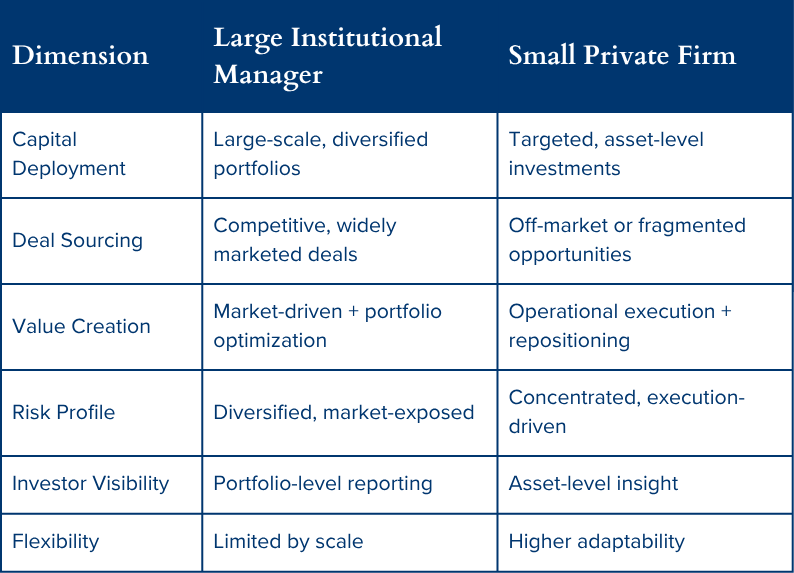
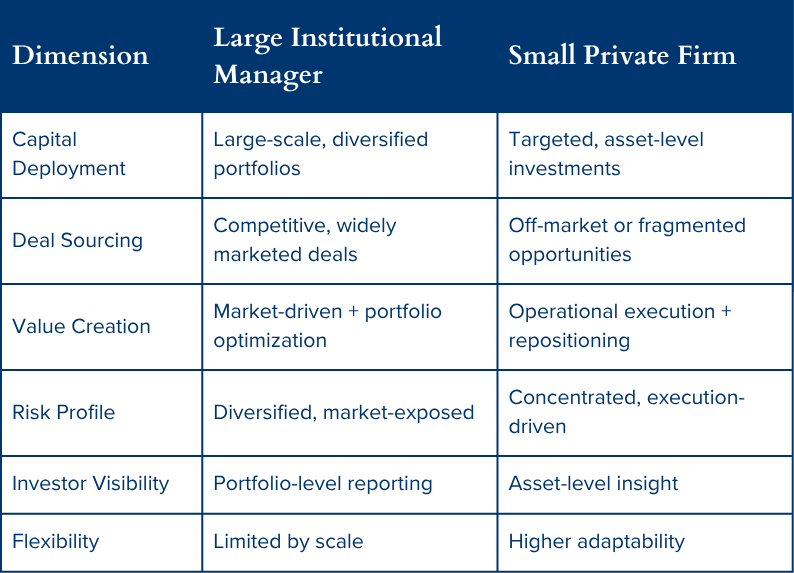
At Hanson Capital, we recognized this shift early. Our focus has always been on identifying high-quality assets and enhancing their value through disciplined, hands-on management. We understand that in today’s market, true alpha is generated not through speculative plays, but through granular, asset-level performance improvements.

When you partner with Hanson Capital, you’re not just investing in real estate; you’re investing in a team dedicated to:

  • Rigorous Due Diligence: Identifying properties with genuine underlying value and strong operational upside.
  • Proactive Management: Implementing best-in-class property management, tenant relations, and cost-control strategies to maximize net operating income.
  • Strategic Capital Allocation: Making targeted improvements that enhance asset utility, efficiency, and appeal, ensuring long-term value appreciation.
  • Resilient Portfolios: Building diversified portfolios designed to perform well across various market conditions.

The era of easy money in private equity real estate is over. The new blueprint for value is being written by firms that prioritize operational excellence, meticulous asset management, and a deep understanding of market dynamics. This shift represents not a challenge, but an opportunity for discerning investors to partner with managers who are equipped to deliver consistent, superior returns in a more demanding environment.

Discover the Difference Operational Excellence Makes

Are you an accredited investor seeking to navigate the evolving private equity real estate market with confidence? Understand how Hanson Capital’s focus on operational excellence can drive robust, sustainable returns for your portfolio.

If you’re curious about how our approach could fit into your portfolio, visit our website or schedule a call to connect with our team. We’d love to talk through what we’re seeing and where we’re going next.