What We Do
 Our Story
 Core Values
 Meet the Team
 Our Approach


For many investors, public real estate investment trusts (REITs) are the default way to gain exposure to real estate.
They are liquid, accessible, and easy to allocate into.
But that accessibility often obscures a more important distinction.
Public REITs and private real estate investments are not interchangeable. They operate under fundamentally different structures, with distinct implications for ownership, control, tax treatment, and ultimately, how returns are generated.
For accredited investors evaluating capital allocation, the question is not simply which option offers stronger performance.
It is a structure that aligns with how capital is intended to behave over time.
What a REIT Actually Represents
A REIT is a publicly traded company that owns and operates a portfolio of real estate assets.
When investing in a REIT, capital is allocated into a corporate structure rather than directly into individual properties. As a result, performance is influenced by both asset-level fundamentals and broader equity market conditions.
This introduces an additional layer of variability.
REIT pricing can move in response to:
- Interest rate expectations
- Public market sentiment
- Capital flows across asset classes
- Sector-level positioning
Over shorter periods, these factors can drive performance independently of underlying real estate fundamentals. That divergence is particularly noticeable during periods of market volatility.
Liquidity provides flexibility. It also connects pricing more closely to public market behavior.
What a Private Syndication Represents
Private real estate syndications also known as Private Equity Real Estate provide exposure to specific assets or portfolios through structured ownership.
Depending on the structure, investors may hold:
- Limited partnership interests
- Membership interests in an entity
- Direct fractional ownership through a tenants-in-common (TIC) structure
In each case, performance is tied more directly to the underlying real estate.
Returns are driven by:
- Income generated from operations
- Leasing activity and tenant quality
- Asset management decisions
- Exit execution
This creates a more direct relationship between asset performance and investment outcomes, particularly in strategies where operational improvements play a central role.
A Structural Comparison
The differences between REITs and private real estate investments are best understood at the structural level.
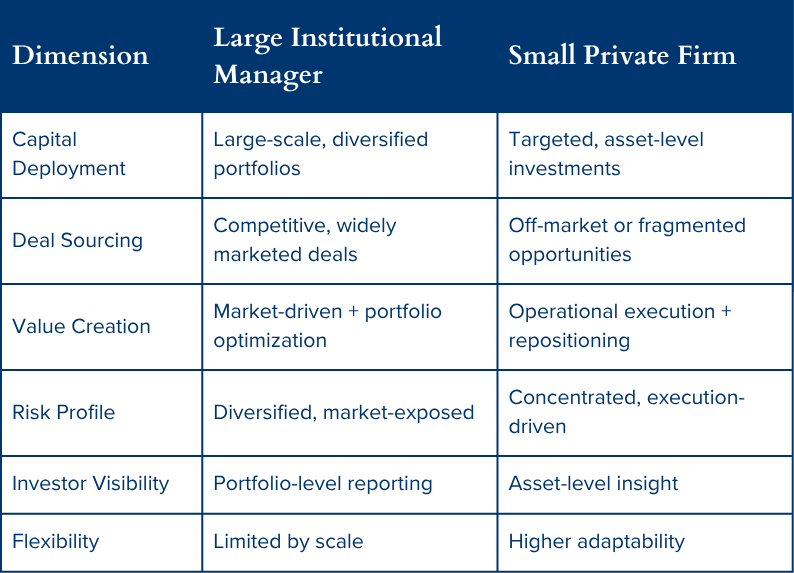
The distinction is less about public versus private and more about indirect exposure versus asset-level participation.
Liquidity and Volatility
Liquidity is often cited as a primary advantage of REITs.
Investors can enter and exit positions quickly, with continuous pricing visibility. However, that same liquidity introduces sensitivity to market sentiment and macroeconomic shifts.
As a result, REIT values may fluctuate even when the underlying properties continue to perform as expected.
Private real estate investments are not repriced daily. Valuations are typically tied to income performance, comparable transactions, and capital market conditions at the time of refinancing or sale.
This does not eliminate risk. It changes how that risk is expressed and when it becomes visible.
Return Drivers: Market Exposure vs. Operational Execution
REIT performance reflects a combination of real estate fundamentals and broader market dynamics. In practice, this can create outcomes that resemble other publicly traded securities during periods of market stress.
Private investments, particularly in asset classes such as multi-tenant industrial, rely more heavily on execution at the property level.
Value is created through:
- Lease rollover and rent adjustments
- Tenant retention and credit quality
- Operational efficiency
- Strategic repositioning
In this context, performance is influenced less by short-term market sentiment and more by the effectiveness of the business plan over the hold period.
This distinction becomes more pronounced in fragmented sectors where operational improvements can be implemented incrementally across multiple tenants and lease cycles.
Tax Treatment and Structural Efficiency
Tax treatment is one of the most meaningful differences between REITs and private real estate investments.
REIT distributions are generally taxed as ordinary income, with limited ability to offset that income through depreciation at the investor level.
Private real estate structures often provide:
- Depreciation that can offset taxable income
- Potential benefits from cost segregation
- The ability to defer capital gains through a 1031 exchange, when structured appropriately
It is important to distinguish between different ownership structures.
Investments structured as securities or partnership interests typically do not qualify for 1031 exchange treatment. Direct ownership structures, such as tenants-in-common (TIC), allow investors to maintain eligibility while participating in larger institutional-quality assets.
Tax efficiency is a function of structure.
Control, Alignment, and Decision-Making
In a REIT structure, investors have no direct involvement in asset-level decisions. Strategy, capital allocation, and execution are determined by the management team of the company.
Private investments operate differently. While investors are generally passive, they participate in a structure where:
- Decisions are tied to specific assets
- Performance is linked to a defined business plan
- Sponsor incentives are often aligned through co-investment
This does not eliminate execution risk. It concentrates it within the operating strategy and the discipline of the sponsor.
Alignment is established through structure, not assumed.
Where Industrial Fits Into the Equation
The structural differences between REITs and private investments become more meaningful when viewed through specific asset classes.
Small-bay industrial has drawn increased attention due to a combination of:
- Limited new supply in infill locations
- A diverse and fragmented tenant base
- Consistent demand from local and regional businesses
- Opportunities for incremental rent growth through lease rollover
These characteristics create multiple points of operational influence over time.
In private structures, that influence is reflected directly in asset performance. In public structures, those same dynamics may be diluted within larger, diversified portfolios and influenced by broader market factors.
Understanding how value is created is as important as identifying where it exists.
When Each Approach Makes Sense
Both REITs and private real estate investments serve a role within a diversified portfolio.
REITs may be appropriate for investors who prioritize:
- Liquidity
- Ease of access
- Public market exposure
Private real estate investments may be more appropriate for investors seeking:
- Direct alignment with asset-level performance
- Tax-efficient income and growth
- Participation in value-add strategies
- Longer-term capital deployment
The choice between the two is less about preference and more about alignment with investment objectives and time horizon.
Strategic Takeaway
The distinction between REITs and private real estate is not simply about access or liquidity.
It is about how ownership is structured, how risk is distributed, and how value is ultimately realized.
For accredited investors, understanding that difference is central to making informed allocation decisions.
Work With Hanson Capital
Hanson Capital specializes in private equity real estate investments focused on high-scarcity industrial assets, disciplined underwriting, and long-term value creation. The firm works with accredited and institutional investors seeking durable income, downside protection, and strategic growth – including 1031 exchange solutions and passive ownership structures.
If you’re curious about how our approach could fit into your portfolio, schedule a call to connect with our team. We’d love to talk through what we’re seeing and where we’re going next.