Categories
Real Estate

Hanson Capital Weekly Newsletter #12– June 4–10: Market Moves & Investor Insights

Market Insight #1: Industrial Vacancy Rises Amid Speculative Supply Surge

The U.S. industrial market is seeing an increase in warehouse vacancies as speculative development continues to outpace current demand. According to CBRE, speculative supply additions—particularly in large distribution corridors—are softening occupancy metrics, with national vacancy hovering around 7.3% in Q2 2025. However, demand remains strong in mid-bay and infill segments, where leasing for 100k–250k s.f. facilities made up 27% of Q1 volume.

Market Insight #2: Private Credit Faces Scrutiny as Retail Access Expands

Moody’s and the SEC have raised concerns about systemic risk in private credit markets, especially as retail channels gain exposure through interval funds and non-traded BDCs. While the sector now exceeds $1.7T globally, transparency and liquidity mismatches could stress fund structures during volatility. Despite this, institutional backing remains strong—HSBC recently committed $4B toward expanding its private credit platform.

Investor Concept of the Week: “Flight to Function” – Why Quality Wins in Industrial

The current leasing environment highlights a shift in tenant behavior. Occupiers are prioritizing well-located, energy-efficient facilities with modern specs—think 32’+ clear heights, ESG-aligned upgrades, and strategic access to transportation nodes. As construction pipelines taper off, properties that offer true utility are absorbing demand, while outdated inventory lags.

Why It Matters:

  • Class A facilities are outperforming on rent growth by ~100 bps over B/C stock. 
  • Functional obsolescence is widening rent spreads, driving consolidation into top-tier space. 
  • Cap rates for stabilized, modern warehouses are holding firmer in volatile capital markets. 

Investor Strategy: Lock in Core Industrial While the Window Is Open

Investors should act now while cap rates are wider and competition is selective. With 86% of 2025’s under-construction inventory expected to deliver by year-end, 2026 may see a supply cliff. This positions today’s acquisitions for favorable rent growth and value appreciation.

Action Plan:

  • Focus on acquiring or repositioning high-functionality assets in supply-constrained markets. 
  • Prioritize properties near key distribution hubs with flexible tenant appeal. 
  • Use near-term macro noise to negotiate on pricing, but underwrite conservatively on rent growth. 

Final Thoughts

Industrial fundamentals remain solid despite headlines. Supply chains are recalibrating, speculative development is cooling, and high-quality facilities continue to lease. Meanwhile, private credit markets are expanding—albeit under a sharper regulatory lens. At Hanson Capital, we’re staying disciplined and opportunistic: targeting industrial assets with long-term durability and deploying private capital where structure and transparency drive outsized risk-adjusted returns.


Categories
Real Estate

Hanson Capital Weekly Newsletter #11– May 28–June 3: Market Moves & Investor Insights

Market Insight #1: Prologis Anticipates Increased U.S. Warehouse Demand Amid Trade Uncertainties

Prologis, the world’s largest industrial real estate company, projects a surge in U.S. warehouse demand as companies adjust to ongoing global trade tensions. Firms like Amazon, Home Depot, and FedEx are proactively securing additional storage space to mitigate tariff impacts and ensure goods are closer to consumers. Despite a recent slowdown in leasing activity and a rise in warehouse vacancy rates to 7% in Q1 2025, Prologis reported a 9.2% revenue increase to $2.14 billion and net earnings of $592 million. The company maintains its full-year earnings guidance, anticipating benefits from reduced warehouse construction limiting supply and sustaining rental rates. (wsj.com)

Market Insight #2: Global Economic Growth Slows Amid Escalating Trade Tensions

The global economic outlook has weakened, with the OECD revising its growth forecast downward to 2.9% for both 2025 and 2026, the lowest since the COVID-19 pandemic. This slowdown is primarily attributed to escalating trade tensions, particularly the U.S. administration’s recent tariff increases, which have raised average effective tariff rates to over 15%, the highest since World War II. These protectionist measures are dampening investment, disrupting supply chains, and increasing inflationary pressures worldwide.

In the United States, GDP growth is projected to decline from 2.8% in 2024 to 1.6% in 2025 and 1.5% in 2026, with inflation expected to reach nearly 4%, potentially delaying Federal Reserve rate cuts. Other G20 nations, including China, India, Japan, the UK, and France, also face downgraded growth forecasts. The OECD emphasizes the urgent need for trade agreements and increased investment to support global recovery.

Investor Concept of the Week: Navigating Industrial Real Estate Amid Global Economic Uncertainty

The current landscape presents both challenges and opportunities for investors in industrial real estate.

Key Insights:

  • Trade Policy Impacts: Uncertainties surrounding trade agreements are influencing investment decisions in key industrial regions.
  • Market Resilience: Despite these uncertainties, the industrial sector continues to demonstrate resilience, with significant transaction volumes and sustained investor interest.

Investor Strategy:

Investors should monitor trade policy developments closely, as resolutions could unlock pent-up demand and investment opportunities. Diversifying portfolios to include regions with strong fundamentals and adaptability to policy shifts can mitigate risks. Additionally, staying informed about macroeconomic trends will be crucial in making strategic investment decisions.

Final Thoughts

As we navigate the complexities of trade policies and global economic shifts, staying informed and adaptable remains paramount. The industrial real estate sector continues to offer opportunities for strategic investors. At Hanson Capital, we are committed to providing insights and guidance to help you make informed investment decisions in this evolving landscape.  We’re spending our entire focus looking for opportunities in a challenging marketplace, but that challenge is what we believe creates the opportunity for great success.  Tomorrow we’ll be sending our May activity report and there are certainly some interesting updates.

Categories
Real Estate

Hanson Capital Weekly Newsletter #10 – May 21–27: Market Moves & Investor Insights

🔹 Market Insight #1: Prologis Launches $1 Billion Logistics Fund Targeting Urban Infill Properties

On May 23, 2025, Prologis Inc. announced the launch of a new $1 billion logistics fund aimed at acquiring urban infill properties in major U.S. metropolitan areas. This strategic move is designed to capitalize on the growing demand for last-mile delivery facilities driven by the continued expansion of e-commerce. The fund will focus on properties located within close proximity to dense population centers, enabling faster delivery times and enhanced supply chain efficiency. Prologis plans to leverage its existing platform and expertise to identify and manage these assets, aiming to generate attractive risk-adjusted returns for investors.

This development underscores the ongoing strength and adaptability of the industrial real estate sector, particularly in the face of evolving consumer behaviors and logistical challenges.

Source: Prologis Press Release, May 23, 2025

🔹 Market Insight #2: Stock Market Rebounds Amid Tariff Delay

U.S. stock markets rebounded this week after President Trump delayed the imposition of a 50% tariff on European Union imports until July 9. The Dow Jones Industrial Average rose over 500 points, while the S&P 500 and Nasdaq gained more than 1%. This delay has temporarily alleviated investor fears of an escalating trade war, contributing to a surge in market optimism.

However, concerns remain about the long-term impact of tariffs on the economy. Analysts warn that increased costs for materials and potential retaliatory measures from trade partners could dampen growth prospects. 

🔹  Investor Concept of the Week: The Importance of Tailored Asset Allocation

Given recent market volatility and economic uncertainties, investors should revisit and refine their asset allocation strategies. A well-tailored asset allocation can significantly impact portfolio resilience and long-term investment outcomes.

Key Considerations:

  • Role of Alternatives: Incorporating alternative investments like real estate and private credit into your portfolio can enhance diversification and potentially mitigate risk due to their lower correlation with traditional asset classes.
  • Strategic Allocation: Adjust your allocation to align with evolving market conditions, ensuring your investment strategy remains responsive to macroeconomic changes such as interest rate fluctuations and tariff impacts.
  • Long-Term Stability: Alternatives, particularly in resilient sectors such as logistics and industrial real estate, can provide stable cash flows and consistent returns even amid broader market uncertainty.

By prioritizing strategic asset allocation, investors can effectively navigate market volatility and capitalize on opportunities within alternative investments.

Final Thoughts

This week’s developments underscore the dynamic nature of the investment landscape. While challenges like tariffs and market volatility persist, strategic investments in high-quality industrial assets continue to offer promising opportunities. At Hanson Capital, we remain committed to identifying and capitalizing on these opportunities to deliver value to our investors.

Categories
Real Estate

Hanson Capital Weekly Newsletter #9 – May 15–21: Market Moves & Investor Insights

Market Insight #1: Treasury Yields Surge Amid Fiscal Concerns

During the week of May 14–20, 2025, the 10-year U.S. Treasury yield experienced significant volatility, peaking at 4.53% on May 14 before settling at 4.46% by May 19. This surge was primarily driven by Moody’s downgrade of the U.S. sovereign credit rating from Aaa to Aa1, citing concerns over the nation’s deteriorating fiscal outlook and escalating national debt. 

The downgrade has heightened investor anxiety, leading to increased borrowing costs across various sectors. For commercial real estate (CRE) investors, rising Treasury yields translate to higher interest rates on new loans, potentially compressing property cash flows and investor returns.

READ MORE

Market Insight #2: Stock Market Rebounds Despite Tariff Concerns

The U.S. stock market showed resilience during the week, with the S&P 500 gaining 0.4% and the Dow Jones Industrial Average rising 0.6%. This rebound comes after initial declines triggered by new tariff announcements. Investors seem to be cautiously optimistic, focusing on strong corporate earnings and economic data.

However, concerns remain about the long-term impact of tariffs on the economy. Analysts warn that increased costs for materials and potential retaliatory measures from trade partners could dampen growth prospects. The industrial real estate sector, in particular, may face challenges due to higher construction costs and supply chain disruptions.

READ MORE

Investor Concept of the Week: Adapting Investment Strategies to Shifts in Trade and Tech

The recent easing of U.S.-China trade tensions and resurgence in the stock market highlight key shifts investors should recognize. As market conditions evolve, it’s crucial to recalibrate your strategy to capitalize effectively.

Key Insights:

  • Trade Stability Means Growth: Improved international relations can boost global commerce, leading to stronger performance in trade-linked sectors such as industrial real estate, logistics, and manufacturing.

  • Tech’s Renewed Strength: The rally in tech stocks, driven by innovation and renewed investor confidence, underscores the sector’s role as a growth engine. However, it also signals the need for balanced risk management to avoid excessive exposure.

Investor Strategy:

Focus on leveraging recent market positivity without sacrificing risk awareness. Consider allocating toward sectors directly benefiting from reduced tariffs—such as logistics hubs and industrial properties with international trade exposure like some of our FTZ (Free Trade Zone) assets in McAllen. 

Final Thoughts

The industrial real estate sector continues to demonstrate resilience amid economic shifts and policy changes. While challenges like tariffs and construction cost increases persist, strong demand fundamentals offer opportunities for strategic investments. At Hanson Capital, we remain committed to identifying and capitalizing on these opportunities to deliver value to our investors.

Categories
Real Estate

Hanson Capital Weekly Newsletter #8– May 7–14: Market Moves & Investor Insights

Market Insight #1: Treasury Yields Surge, Elevating CRE Borrowing Costs

During the week of May 7 to May 14, 2025, the 10-year U.S. Treasury yield increased from 4.26% to 4.53%, a rise of 27 basis points. This uptick directly impacts commercial real estate (CRE) borrowing costs, as the 10-year Treasury serves as a benchmark for many CRE loans. Higher yields typically lead to increased interest rates on new loans, potentially compressing property cash flows and investor returns.

Investors are advised to monitor this trend closely, focusing on assets with strong, reliable cash flows and limited exposure to variable interest rate risks. Multi-tenant industrial properties and stabilized warehouse assets remain particularly attractive under current conditions, offering greater stability in an uncertain interest rate environment.

Sources:

Market Insight #2: Industrial Real Estate Shows Resilience Amid Economic Shifts

Despite economic uncertainties, the U.S. industrial real estate market demonstrated resilience in Q1 2025. According to CBRE, the overall vacancy rate rose by 20 basis points to 6.3%, the highest since Q2 2014, yet leasing activity remained solid. Net absorption was modestly positive at 23.3 million square feet, indicating continued demand. Construction completions fell to their lowest quarterly level since Q2 2018 at 64.6 million square feet, suggesting a slowdown in new supply. (CBRE)

Markets in the U.S. Southwest, including Arizona, Nevada, and Texas, remain particularly robust due to strategic geographic advantages, favorable demographics, and sustained population growth.

Source:

Investor Concept of the Week: Understanding Debt Service Coverage Ratio (DSCR)

In the context of rising interest rates, understanding the Debt Service Coverage Ratio (DSCR) is crucial for investors. DSCR measures a property’s available cash flow relative to its debt obligations, providing insight into financial health.

Key Insights:

  • Calculating DSCR: DSCR is calculated by dividing Net Operating Income (NOI) by annual debt service (principal + interest payments). A DSCR above 1 indicates sufficient cash flow to cover debt payments, while values below 1 suggest potential financial stress.

  • Impact of Rising Rates: Higher interest rates increase debt payments, making it essential for investors to ensure properties maintain a healthy DSCR to safeguard against market fluctuations and ensure long-term financial stability.

Investor Strategy:
When evaluating CRE investments in a high-interest-rate environment, prioritize properties that consistently maintain a DSCR well above lender minimums (typically 1.25 or higher). Focus on assets with strong operating fundamentals, stable tenant bases, and strategic locations to enhance financial resilience and investment returns.

Final Thoughts

This week’s market movements underscore the importance of disciplined investment strategies that account for shifting interest rates and economic conditions. At Hanson Capital, we remain focused on assets with stable cash flows and strategic advantages, helping investors navigate market volatility and achieve long-term growth.

Categories
Real Estate

Hanson Capital Weekly Newsletter #7 – April 30–May 6: Market Moves & Investor Insights

Market Insight #1: Industrial Real Estate Investment Surges Amid Price Corrections

Brookfield Asset Management recently raised a record-breaking $16 billion for its new global opportunistic real estate fund, with $5.9 billion secured in Q1 2025 alone. The fund targets distressed commercial properties, capitalizing on price drops of 20% to 40% from peak levels. Investments include apartment buildings and warehouses, notably a significant acquisition of European logistics firm Tritax EuroBox, highlighting increased investor appetite for value-driven opportunities within industrial real estate.

Source:

Market Insight #2: Stock Market Volatility Reflects Economic Uncertainty

This article from Morgan Stanley hit home, and aligns with how April brought heightened volatility to the stock market. With the S&P 500 entering bear market territory—down more than 20% from its recent peak. Primary drivers include rising trade tensions and ongoing policy uncertainty from Washington. Although markets briefly rallied, investor sentiment remains cautious given the persistent concerns around long-term economic stability and policy direction.

Sources:

Investor Concept of the Week: Diversification as a Key Strategy in Volatile Markets

This week’s volatility across financial markets underscores a fundamental principle of investment: diversification. Rather than focusing solely on one asset type, strategic investors maintain exposure across asset classes—stocks, bonds, real estate, and alternative investments—to balance risk and potential returns.

Key Insights:

  • Volatility as Opportunity: Market fluctuations, though challenging, often present opportunities for repositioning portfolios strategically. 
  • Balancing Risk: Diversification helps mitigate the impact of market swings and provides steadier long-term returns. 

Investor Strategy:
Regularly assess and rebalance portfolios, aligning your investments with both your financial goals and evolving market dynamics. Thoughtful diversification across asset types provides resilience during periods of uncertainty.

Final Thoughts

This week’s developments serve as a timely reminder that economic cycles—and volatility—are inevitable. Rather than chasing short-term trends or reacting to headlines, informed investors benefit most from maintaining clarity on their long-term strategies and understanding how broader market shifts might impact their portfolio goals. We aim to keep you informed each week so you can stay proactive, aware, and adaptable.

Categories
Real Estate

Hanson Capital Weekly Newsletter #6– April 23–29: Market Moves & Investor Insights

Market Insight #1: Prologis Reports Increased Demand Amid Trade Uncertainty

Prologis, the world’s largest industrial real estate company, anticipates ongoing global trade tensions will drive increased demand for U.S. warehouse space. Companies are strategically stockpiling goods closer to consumers to mitigate tariff-related supply chain disruptions, leading to a surge in leasing activity.

Despite recent slowing of leasing activity and warehouse vacancy rates edging upward to 7% in Q1 2025, Prologis posted strong financial results, including a 9.2% revenue increase to $2.14 billion and net earnings of $592 million. The firm maintains its full-year earnings guidance, predicting further strength as limited warehouse construction constrains new supply and sustains rental rates.

Source:

Market Insight #2: Financial Markets Send Mixed Signals Amid Economic Uncertainty

April 2025 has brought unusual behavior in financial markets, as both stocks and bonds experienced simultaneous gains—a rare occurrence causing concern among analysts about potential synchronized declines ahead. Many attribute this anomaly to erratic U.S. policy shifts and lingering economic uncertainties.

A recent JPMorgan investor survey underscores this uncertainty: 93% expect the S&P 500 to remain at or below 6,000 over the next year, with nearly a third predicting a fall below 5,000. These forecasts represent a stark shift from earlier bullish sentiment, driven by fears of stagflation and unpredictable economic policies.

Sources:

Investor Concept of the Week: Capitalizing on Real Estate Resilience Amid Market Uncertainty

The current market presents contrasting signals: industrial real estate continues demonstrating resilience, driven by strategic shifts in global trade and supply chains, while financial markets grapple with volatility and economic uncertainty.

Key Insights:

  • Industrial Stability: Prologis’s recent performance highlights ongoing demand strength in strategically positioned warehouse spaces, indicating industrial real estate as a stable asset class amid market turbulence. 
  • Financial Market Volatility: Investors express caution due to rare simultaneous strength in stocks and bonds, signaling potential for market volatility and uncertainty ahead. 

Investor Move:
In volatile market conditions, investors should lean into assets like industrial real estate that show fundamental resilience and steady tenant demand. These uncertain times give us more conviction on why we like multi-tenant diversified cash flow in our investment targets today.  Prioritize strategically located, operationally strong industrial properties that can weather short-term economic fluctuations.

Final Thoughts

Despite heightened financial market uncertainties, industrial real estate remains a bright spot, supported by structural trends such as reshoring, e-commerce, and robust logistics demand. Hanson Capital continues to position our portfolio toward these resilient opportunities, aligning our strategies with evolving market conditions to protect and grow investor capital, although with the uncertainty, we’re shifting our risk reward profile towards acquisition over new development.

Categories
Real Estate

Hanson Capital Weekly Newsletter #5 – April 16–22: Market Moves & Investor Insights

Market Insight #1: Industrial Leasing Activity Rebounds in Q1 2025

The U.S. industrial real estate sector is showing signs of momentum. According to JLL, leasing activity reached 123.3 million square feet in Q1 2025—the strongest quarter since Q2 of last year. Leasing for spaces between 100,000 and 250,000 square feet made up over 27% of the total, indicating robust demand in the mid-bay segment although vacancy edged up to 7.3%, driven largely by deliveries of unleased new product. While that’s still healthy by historical standards, it signals that tenant selectivity is returning to the market

Source:

Market Insight #2: Tariff Uncertainty Impacts Construction Costs and Project Timelines

Recent tariff policies have introduced new challenges for industrial developers. According to a report by Business Insider, tariffs on imported steel and aluminum have led to significant cost increases for construction materials. For instance, a warehouse project in Newark experienced an 8–10% rise in steel costs, adding approximately $2 million to the budget These escalating costs are causing developers to reconsider project timelines and budgets, potentially leading to delays or cancellations of planned developments. The uncertainty surrounding future tariff implementations further complicates long-term planning in the industrial construction sector

Source:

Investor Concept of the Week: Navigating a Market with Rising Demand and Construction Headwinds

The industrial real estate landscape in Q1 2025 presents a complex picture: strong leasing activity indicates robust demand, particularly in the mid-bay segment, while rising construction costs and tariff-related uncertainties pose challenges for new developments

Key Takeaways:

  • Strong Demand: Leasing activity has rebounded, with significant absorption in mid-sized industrial spaces 
  • Construction Challenges: Tariff-induced cost increases are impacting project budgets and timelines, leading to potential delays in new supply 

Investor Strategy: In this environment, investors should focus on existing, well-located industrial assets that can capitalize on the current demand without the risks associated with new construction. Emphasizing properties in the small and mid-bay segment may offer the best opportunities for stable returns amid these market dynamics

Final Thoughts

The current industrial real estate market offers both opportunities and challenges. While demand remains strong, external factors like tariffs are influencing the supply side. At Hanson Capital, we continue to identify and invest in assets that align with these evolving market conditions, ensuring value and resilience in our portfolio

Categories
Real Estate

Hanson Capital Weekly Newsletter #4 – April 9–15: Market Moves & Investor Insights

Market Insights: Blackstone’s $718M Bet on Industrial Real Estate

Blackstone has announced a $718 million acquisition of a 6 million square foot industrial portfolio developed by Crow Holdings. The 25 buildings are primarily located in high-barrier submarkets in Dallas and Houston, reinforcing Blackstone’s conviction in well-positioned logistics hubs with long-term value.

This move reflects a clear institutional preference for stabilized, infill industrial assets with strong tenant demand and limited competing supply—especially in markets with strong population and job growth.

Source:

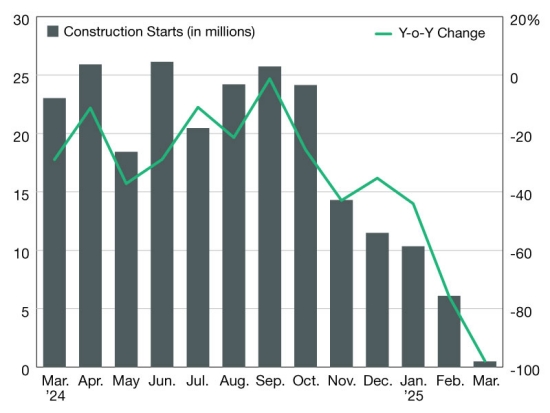
Investor Concept of the Week: Industrial Construction Starts Decline Sharply

The industrial real estate sector is experiencing a noticeable pullback in new construction. With rising interest rates and a more measured tenant demand outlook, developers are tapping the brakes—and fast. From personal discussions most of the institutions I’m talking to are passing on development over future materials price fluctuations risk attributed to the tariff and trade wars.  

Key Highlights:

  • In February 2025, new industrial construction starts totaled just 6.1 million square feet, a 75.8% drop from the same month last year.
  • January 2025 saw only 10.3 million square feet of starts, down 44% year-over-year.

This cooling in new development is setting the stage for stronger performance in existing assets, especially those in key logistics corridors.

📉 Visual Overview:

Chart of industrial construction starts in the U.S. showing monthly and year-over-year fluctuations, as per CommercialEdge data.

Source: CommercialSearch a Yardi Company

Investor Takeaway:
Reduced supply growth often leads to tighter market fundamentals. For investors, that translates to more pricing power, stronger rent growth, and better tenant retention—especially in stabilized, well-located product.

Now is the time to focus on operating assets that are positioned to benefit from this supply constraint.

Final Thoughts

Institutional capital is pouring into industrial, and the data tells a consistent story: construction is slowing, while demand remains durable. These dynamics create a sweet spot for investors with the right strategy.

At Hanson Capital, we continue to target infill industrial opportunities in supply-constrained markets like Houston, Dallas, and Phoenix—locations with real tenant demand and long-term upside.  We closed on a Houston asset 3 weeks ago and secured a contract on 3 more properties in Houston yesterday, more to come.

Categories
Real Estate

Hanson Capital Weekly Newsletter #3 – April 2–8: Market Moves & Investor Insights

Market Insights: Tariff Policies Shift Demand Within Industrial Real Estate

Recent tariff developments industrial real estate from the U.S. administration are beginning to ripple through the industrial real estate landscape. Major port markets on the East and West Coasts—including Los Angeles, New York/New Jersey, and Oakland—may experience softer demand as foreign trade volumes adjust.

At the same time, inland and strategically positioned logistics hubs like Houston are expected to remain resilient. Houston’s diversified port system, proximity to Latin American trade routes, and growing manufacturing base continue to support long-term demand.

Potential Shifts:

  • Inland Growth Corridors: Regions like Arizona, Texas, and Georgia stand to benefit from reshoring and manufacturing expansion, increasing demand for modern industrial product.
  • Supply Chain Reconfiguration: Companies are accelerating investment in distribution centers that support a mix of domestic production and nearshoring strategies.

Investor Takeaway:
While certain coastal markets may face short-term volatility, diversified logistics markets with long-term infrastructure advantages—like Houston—remain attractive. Investors should consider asset positioning within trade-resilient markets as supply chains adapt.

Sources:

Investor Concept of the Week: Why Tariff Policy Should Be on Your CRE Radar

Tariff headlines may feel like political noise, but they can directly influence tenant behavior, supply chain strategy, and ultimately property performance.

Here’s why it matters:

  • Import-dependent tenants may pause expansion or consolidate space in coastal regions facing decreased volume.
  • Domestic and nearshoring manufacturers are increasing demand for space in centrally located logistics corridors.
  • Tariffs can impact build costs, affecting the pace and feasibility of new industrial development.

Investor Move:
In a policy-driven market, strategic location matters more than ever. Look to submarkets with diversified tenant bases, lower dependency on global imports, and regional distribution advantages.

Sources:

Final Thoughts

Macro policy shifts like tariffs tend to create winners and losers in commercial real estate. The good news: we’ve built our strategy around resilient, infill industrial locations that continue to benefit from long-term trends like e-commerce, reshoring, and last-mile logistics.

At Hanson Capital, we believe now is the time to lean into markets like Houston, Phoenix, and Atlanta—where demand is sticky, supply is controlled, and tenants need space to operate regardless of what’s happening overseas.