What We Do
 Our Story
 Core Values
 Meet the Team
 Our Approach


For many investors, allocating capital to real estate begins with a familiar question:
“Should you invest alongside a large institutional manager, or partner with a smaller private firm?”
At first glance, the distinction appears to be about scale. Larger managers offer size, brand recognition, and diversification. Smaller firms offer access, focus, and potential upside.
But that framing misses the more important point.
The difference is not simply scale. It is how capital is deployed, how value is created, and how risk is distributed.
For an investor allocating $500,000, those structural differences matter.
Why This Comparison Matters
At the institutional level, portfolio construction is driven by diversification across dozens or hundreds of assets.
At the individual investor level, allocation decisions are more concentrated.
A $500K investment is not a broad portfolio. It is a meaningful exposure to a specific strategy, operator, and set of assets.
That changes the evaluation.
The relevant question becomes: What is my capital actually exposed to?
How Large Institutional Managers Deploy Capital
Large institutional real estate managers typically allocate capital across diversified portfolios of stabilized assets.
These platforms are designed for:
- Scale
- Consistency
- Capital deployment efficiency
Assets are often:
- Larger in size
- Located in core or core-plus markets
- Acquired through competitive processes
Returns are generally driven by:
- Income stability
- Moderate appreciation
- Portfolio-level performance
Because capital must be deployed at scale, these managers often compete in highly efficient markets where pricing reflects broad investor demand.
Opportunities for mispricing tend to be limited.
How Smaller Private Firms Operate
Smaller private real estate firms operate under a different set of constraints and advantages.
They are not required to deploy billions of dollars across large portfolios. Instead, they can focus on:
- Niche asset classes
- Fragmented markets
- Operationally intensive opportunities
This often includes assets that are:
- Below institutional scale thresholds
- Under-managed or mispriced
- Requiring active repositioning
Returns in these strategies are more closely tied to:
- Execution at the asset level
- Lease management
- Cost control
- Strategic improvements
The distinction is not size alone. It is the degree to which performance depends on operational decision-making.
A Structural Comparison
The differences between these approaches become clearer when viewed across key dimensions:
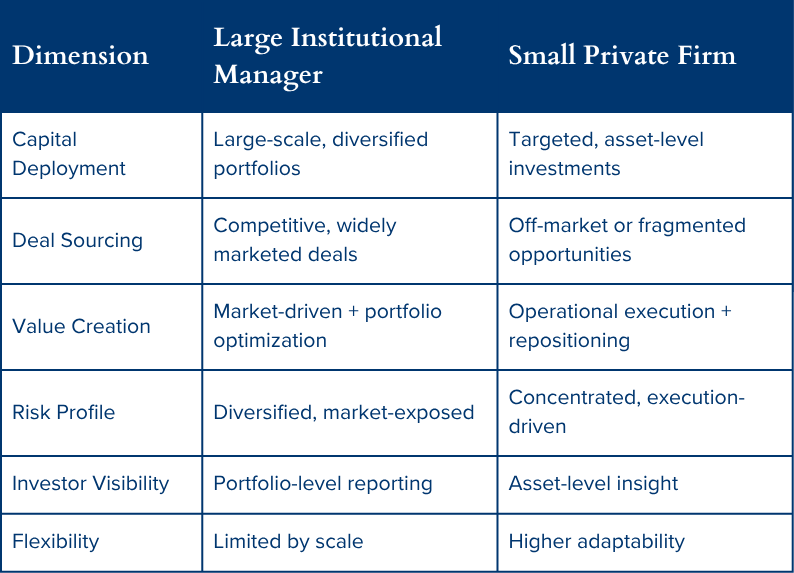
The tradeoff is not better or worse. It is diversification versus control and scale versus precision.
Value Creation: Market Exposure vs. Execution
One of the most important differences lies in how value is created.
Institutional portfolios often rely on:
- Broad market trends
- Capital appreciation across asset classes
- Incremental improvements at scale
This approach can perform well in stable or expanding markets.
Smaller firms, particularly in sectors such as multi-tenant industrial, tend to rely more heavily on execution.
Value is created through:
- Bringing below-market rents to current levels
- Improving tenant mix
- Enhancing property operations
- Repositioning underutilized assets
These are not passive outcomes. They are the result of deliberate actions taken over time.
This introduces a different return dynamic.
Performance is less dependent on market movement and more influenced by how effectively the business plan is executed.
Risk and Return Trade-offs
The structural differences between large and small managers translate directly into how risk is experienced.
Institutional portfolios distribute risk across many assets. This reduces exposure to any single property but increases sensitivity to broader market conditions.
Smaller firms concentrate capital into fewer assets. This increases exposure to individual outcomes but also provides greater control over how those outcomes are managed.
For a $500K investor, this distinction is important.
A diversified institutional fund may provide stability, but the investor is sacrificing return potential for that stability.
A concentrated investment introduces execution risk, but the performance drivers are more visible and, in some cases, more controllable and often lead to a better risk-adjusted return.
Understanding where risk resides is more important than simply trying to minimize it.
What $500K Actually Buys You
At a $500K allocation level, structure becomes especially relevant.
With a large institutional manager, that capital typically represents a small fraction of a broader fund. The investor gains exposure to a diversified portfolio but has limited visibility into individual assets.
With a smaller private firm, the same $500K may represent a more direct stake in a defined set of properties or a specific strategy.
That difference affects:
- Transparency
- Understanding of performance drivers
- Connection between decisions and outcomes
In smaller, execution-driven strategies, investors often have clearer insight into how value is being created and where risks exist.
This does not eliminate risk. It changes how it is understood.
Where Industrial Strategies Fit
These structural differences become more pronounced within fragmented sectors such as multi-tenant industrial and small-bay industrial assets.
Unlike large institutional asset classes that trade efficiently at scale, many smaller industrial properties remain operationally intensive, locally driven, and fragmented across private ownership groups. As a result, these assets have historically fallen below the acquisition thresholds of many large institutional managers despite benefiting from strong long-term industrial fundamentals.
These properties often feature:
- Fragmented ownership
- Below-market rents
- Strong local demand
- Limited new supply in infill markets
That fragmentation can create inefficiencies that are difficult to access within larger institutional structures.
In sectors like small-bay industrial, value creation is often driven less by broad market appreciation and more by operational execution at the asset level. Lease restructuring, tenant placement, rent mark-to-market opportunities, and property repositioning can materially influence outcomes over time.
In this environment, precision can matter more than scale.
Specialized operators with deep market knowledge and operational focus may be better positioned to identify opportunities that larger capital pools cannot pursue efficiently.
When Each Approach Makes Sense
Both large institutional managers and smaller private firms can serve a role within a real estate allocation strategy.
Institutional managers may remain appropriate for investors prioritizing:
- Broad diversification
- Lower asset-specific exposure
- Passive participation across larger portfolios
Smaller private firms may be more appropriate for investors seeking:
- Direct alignment with asset-level performance
- Exposure to operational value creation
- Targeted strategies within specific asset classes
However, in more fragmented sectors where operational execution directly influences performance, smaller specialized firms may offer advantages that are difficult to replicate at an institutional scale.
This is particularly relevant in sectors such as small-bay industrial, where sourcing, tenant management, lease execution, and local market knowledge can materially affect long-term value creation.
For investors willing to accept more concentrated exposure in exchange for greater alignment with asset-level execution, specialized industrial strategies may provide a differentiated return profile compared to larger diversified portfolios.
The decision is ultimately less about size alone and more about where structural inefficiencies still exist within the market.
Strategic Takeaway
The choice between a large institutional manager and a smaller private firm is not simply a matter of scale.
It is a decision about how value is created.
In highly efficient institutional markets, performance often becomes increasingly tied to broad market exposure and capital flows. In fragmented sectors such as small-bay industrial, operational execution, local market expertise, and disciplined asset management may play a far larger role in shaping outcomes.
For many investors, that distinction is becoming increasingly important.
Understanding where inefficiencies still exist – and which operators are positioned to capitalize on them – may ultimately matter more than manager size alone.
Work With Hanson Capital
Hanson Capital specializes in private equity real estate investments focused on high-scarcity industrial assets, disciplined underwriting, and long-term value creation. The firm works with accredited and institutional investors seeking durable income, downside protection, and strategic growth – including 1031 exchange solutions and passive ownership structures.
If you’re curious about how our approach could fit into your portfolio, schedule a call to connect with our team. We’d love to talk through what we’re seeing and where we’re going next.